Musical Cities

The Evergreen State College

Page 21 of 35

Week 2 Response

There are in our existence spots of time,
That with distinct pre-eminence retain
A renovating virtue…
That penetrates, enables us to mount,
When high, more high, and lifts us up when fallen.
-William Wordsworth


Wordsworth was a man who appreciated the beauty of nature. He sought it out as a way of restoring peace to his soul, believing that nature was a “necessary antidote to the evils of the city” (Botton, 196). During his time things were changing rapidly. With the Industrial Revolution in full swing, cities and their populations were expanding. As a result, many people, such as the Transcendentalists (Henry David Thoreau, Ralph Waldo Emerson…), sought solace from the increasingly fast-paced lifestyle of the city by returning to nature.

Botton wrote at length about human admiration for nature. On page 144 he described his experience under oaks in the Lake District while it rained: “From under their canopy, rain could be heard falling on forty thousand leaves, creating a harmonious pitter-patter that varied in pitch according to whether the water dripped onto a large or small leaf, a high or low one, one loaded with accumulated water or not. The trees themselves were an image of ordered complexity…” Such scenes as these are what Wordsworth meant when he wrote about “spots of time.” They speak of forces which are beyond our comprehension and leave us in awe.

It’s not surprising then that those who sought nature often found an “emotional connection to a greater power” (Botton, 169). In the first chapter of his book, Nature, Ralph Waldo Emerson wrote:


I become a transparent eye-ball; I am nothing; I see all; the currents of the Universal Being circulate through me; I am part or particle of God. The name of the nearest friend sounds then foreign and accidental: to be brothers, to be acquaintances, — master or servant, is then a trifle and a disturbance. I am the lover of uncontained and immortal beauty. In the wilderness, I find something more dear and connate than in streets or villages. In the tranquil landscape, and especially in the distant line of the horizon, man beholds somewhat as beautiful as his own nature.”

What Emerson describes resembles a spiritual sense of the sublime, something which Botton elaborates on greatly in his sixth chapter. I bought a used copy of The Art of Travel. On page 163, the first page of the aforementioned chapter, the previous owner highlighted “I set out to the desert so as to be made to feel small,” and aside it wrote, “Trees!” I was reminded of the Evergreen woods. Having been raised on the east coast, the trees there seem alien and beautiful. Their trunks stretch high, and their limbs seem languidly twisted, coated in vibrantly green moss. As a part of my study, I plan to visit the Olympic National Park where the trees grow much bigger, and I don’t doubt that I will feel humbled by their size and age. While I’m not sure I’ll find the same spirituality that Emerson describes, I do think we are drawn to nature’s majestic indifference as it reminds us of our own temporariness.

However, while it is important for us to appreciate the beauty of nature, we must also not forget about the beauty of our own creations. Botton seems aware of this when, on page 181, he wrote about an oil refinery “whose tangle of pipes and cooling towers spoke of the complexity involved in the manufacture of a liquid that [he] was used to putting into [his] car with scant thought for its origins.” In chapter four of his book, Walden, Thoreau marvels at a train, writing “…when I hear the iron horse make the hills echo with his snort like thunder, shaking the earth with his feet, and breathing fire and smoke from his nostrils (what kind of winged horse or fiery dragon they will put into the new Mythology I don’t know), it seems as if the earth had got a race now worthy to inhabit it.” It is perhaps easier for us to take our own achievements for granted because they represent those elements of nature which we have already mastered. Our technologies are the aspects of nature which we have molded to our will.

We are at once a part of and separate from nature. While we are but small parts of it, our will is distinct. The “will” of nature, something which we tend to embody in the image of the divine, is “a defiance to man’s will” (Botton, 164). Nature may be seen in this way as a challenge which is not so different from a blank canvas. As I move forward in my study, I’ll be interested to carry Botton’s thoughts on nature and art with me, testing them against the theories other philosophers have generated over the centuries.


Work Cited:


Botton, Alain De. The Art of Travel. New York: Pantheon, 2002. Print.

Emerson, Ralph W. “Chapter I: Nature.” Nature. N.p., n.d. Web. 08 Apr. 2015.

Thoreau, Henry D. “Chapter 4: Sounds.” Walden. N.p., n.d. Web. 08 Apr. 2015.


Spots of Time

There are in our existence spots of time, that with distinct pre-eminence retain A renovating virtue… That penetrates, enables us to mount, When high, more high, and lifts us up when fallen… (William Wordsworth, The Prelude) William Wordsworth was an admirer of those parts of nature which others easily cast aside. He believed that nature […]

There are in our existence spots of time…

There are in our existence spots of time,
That with distinct pre-eminence retain
A renovating virtue, whence—depressed
Or aught of heavier or more deadly weight,
In trivial occupations, and the round
Of ordinary intercourse—our minds
Are nourished and invisibly repaired;
A virtue, by which pleasure is enhanced,
That penetrates, enables us to mount,
When high, more high, and lifts us up when fallen.

-from The Prelude by William Wordsworth


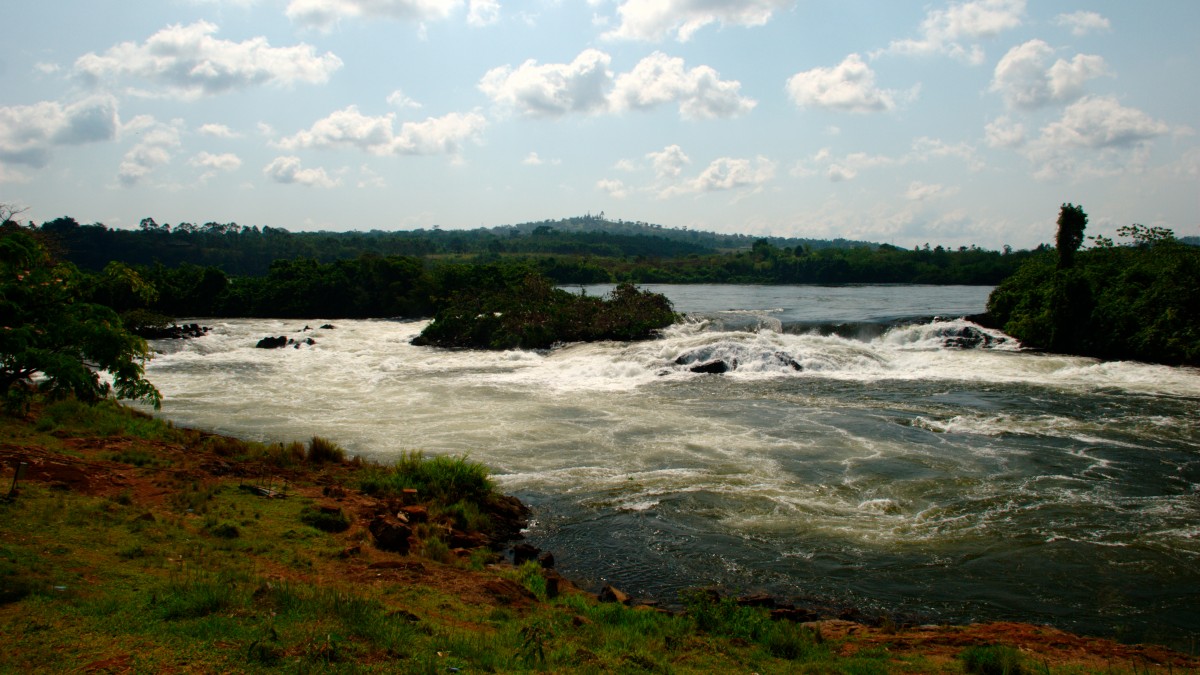
Alain de Botton highlights the preceding section of The Prelude by William Wordsworth in The Art of Travel. De Botton explains that “we may see in nature certain scenes that will stay with us throughout our lives and offer us, every time they enter our consciousness, both a contrast to and relief from present difficulties. [Wordsworth] termed such experiences in nature ‘spots in time’” (de Botton 151). I have a vague memory of one such spot in time from when I still lived in Uganda. I was about 5 years old and I accompanied my father on a work trip. On the way we stopped by a section of rapids in the Nile and I can still recall that image (although probably embellished by time) of the swiftly moving waters.

Bujagali FallsBujagali Falls, Uganda

Much like nature, music has the ability to create these ‘spots of time.’ We often use music as a means of communicating a message where words would not be sufficient to convey our true meanings and intentions. Wordsworth wrote to a student in the summer of 1802 that “’a great Poet…ought to a certain degree to rectify men’s feelings…to render their feelings more sane, pure and permanent, in short, more consonant to Nature’” (Wordsworth qtd. de Botton 145). I have often found music and dance to have a similar effect on me.

Wordsworth proposed that nature could “dispose us to seek our in life and in one another ‘whate’er there is desirable and good’” (de Botton 144). I have often found this to be true. Spending time in the forest usually allows me to clear my mind of much of the clutter that often develops when I am steeped purely in urban life. I wonder what the results would be if we were able to make our urban environments more harmonious with the natural environments that surround them. I am inclined to believe that this would help improve both the living conditions within the city as well as the creative capacity of the city’s community.

De Botton states that “if we are to accept (even in part) Wordsworth’s argument, we may need to concede a prior principle holding that our identities are to a greater or lesser extent malleable, changing according to whom—and sometimes what—we are with” (de Botton 145). This is another claim that my personal experience (although I do not wish to claim that my experiences speak for everyone or even anyone else) seems to corroborate. The people we spend time with, the music we listen to, the visual art we see, among the many other interactions we encounter in our lives all have an effect on our identities and the way we perceive the world.

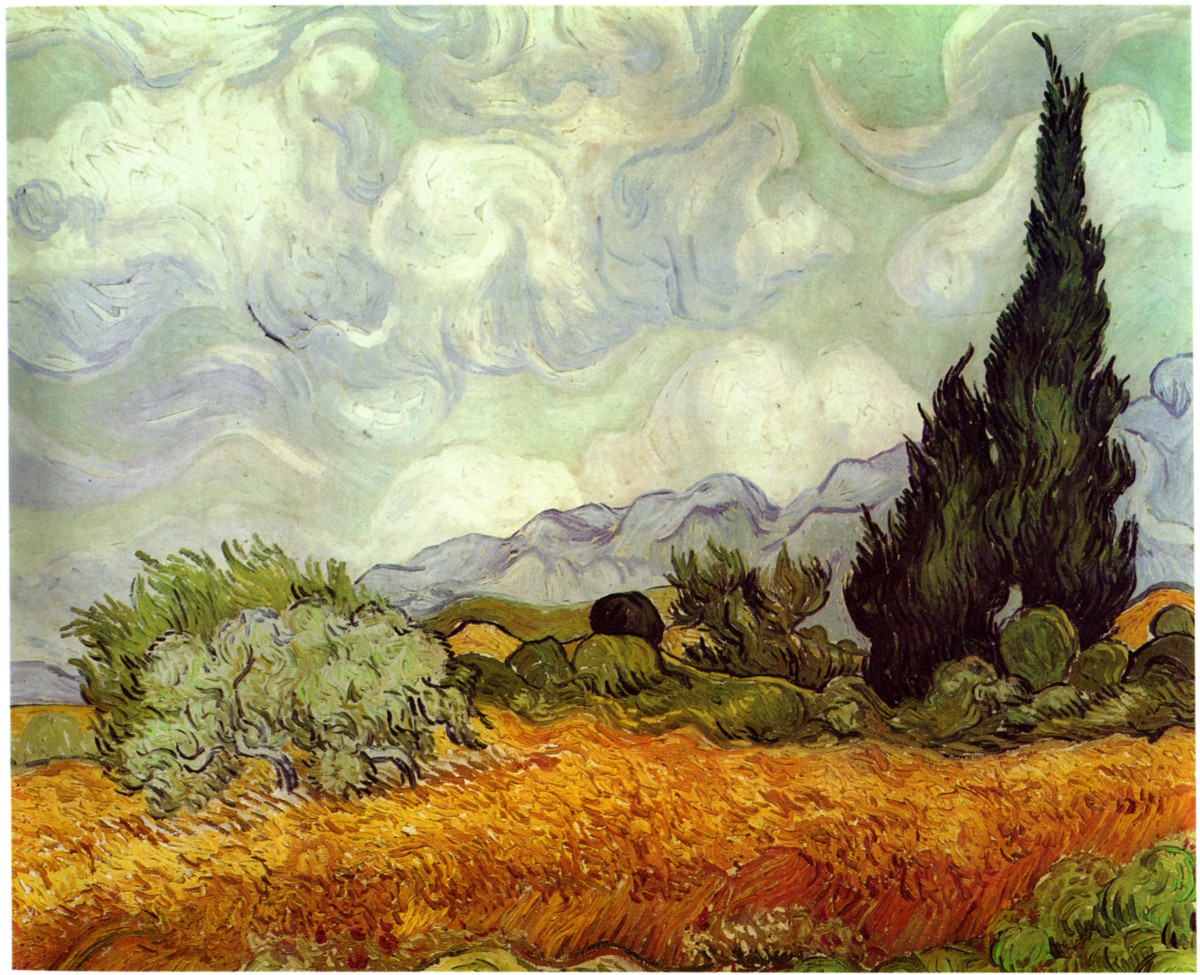
Vincent_Van_Gogh_0020Wheat Field with Cypresses by Vincent van Gogh

De Botton also discusses the ways in which Vincent van Gogh was able to change perceptions of a place through his artwork. By selecting the features he accentuated in his paintings, van Gogh was able to draw the attention of the viewer to those aspects of a scene which he connected to the most. This in turn has made viewers of his artwork more receptive to similar scenes in the natural world. De Botton goes on to say that “art cannot single-handedly create enthusiasm, nor does it arise from sentiments of which nonartists are devoid; it merely contributes to enthusiasm and guides us to be more conscious of feelings that we might previously have experienced only tentatively or hurriedly” (de Botton 209). Experiencing works of art can help open our eyes to new ways of looking at the world.

While I am in Kampala I hope to explore some of the ways in which the art created there inspires new ways of seeing. In addition to the time I spend in the city, I am going to spend some time in the many natural landscapes of Uganda. The works of art I see in the city will help inform the way I view the natural landscapes and in return the natural landscapes will help inform the way I experience the works of art.

I want to end this post with one of my favorite poems by Wordsworth:

The world is too much with us; late and soon,
Getting and spending, we lay waste our powers;—
Little we see in Nature that is ours;
We have given our hearts away, a sordid boon!
This Sea that bares her bosom to the moon;
The winds that will be howling at all hours,
And are up-gathered now like sleeping flowers;
For this, for everything, we are out of tune;
It moves us not. Great God! I’d rather be
A Pagan suckled in a creed outworn;
So might I, standing on this pleasant lea,
Have glimpses that would make me less forlorn;
Have sight of Proteus rising from the sea;
Or hear old Triton blow his wreathèd horn.


Works Cited:

Botton, Alain De. The Art of Travel. New York: Pantheon, 2002. Print.

Wordsworth, William. “The Prelude.” The Complete Poetical Works. London: Macmillan and Co., 1888; Bartleby.com, 1999. www.bartleby.com/145/. 4/7/2015.

Wordsworth, William. “The world is too much with us.” The Complete Poetical Works. London: Macmillan and Co., 1888; Bartleby.com, 1999. www.bartleby.com/145/. 4/7/2015.


Image Sources:

Bujagali Falls, Uganda

Wheat Field with Cypresses by Vincent van Gogh

On Possessing Beauty

This week I have been slowly adding and checking things off my list of to-dos. It feels as though no matter how hard I try to prepare everything for this trip, there will be something very important I will forget to do…. But I’m starting to realize that It probably won’t matter. If I can get into and out of the country and am able to access money while abroad, I will probably be just fine.

In this weeks reading of Alain De Botton’s The art of Travel, I was interested in the bit that focused on beauty, as that is something that has come up frequently over the course of my studies in Musical Cities. De Botton writes about John Ruskin in chapter 8 and his views on beauty.

“Ruskin’s interest in beauty and in its possession led him to five central conclusions. First, beauty is the result of a number of complex factors that affected the mind both psychologically and visually” (217).

As travelers who will be writing about our time in a city that is new to us, or is a place we have yet to look at as critically as we are about to, we must not pull only from the visual side of beauty but also the psychological side. This is crucial to what Ruskin calls word painting, which he thinks we are all capable of. From what I understand, word painting is just a written form of the beauty one sees in something. Our failure to word paint a result of our not asking ourselves enough questions and not being precise enough in analysing what we have seen and felt.

“Second, humans had an innate tendency to respond to beauty and to desire to possess it. Third, there are many lower expressions of this desire for possession (including, as we have seen, buying souvenirs and carpets, carving one’s name on a pillar and taking photographs). Fourth, there was only one way to possess beauty properly, and that was by understanding it, by making oneself conscious of the factors (psychological and visual) responsible for it. And last, the most effective means of pursuing this conscious understanding was by attempting to describe beautiful places through art, by writing about or drawing them, irrespective of whether one happened to have any talent for doing so” (217).

I think Ruskin’s last point is the most important to me as an artist who often struggles with the thought that my work isn’t good enough to share with others. Or that I’m not painting with my words clearly enough for others to see the beauty I see in a landscape or an object. But thinking like that misses the point entirely. What Ruskin desires for us all is that through drawing and writing (and making music), whether we are traveling or not, we gain a better understanding of beauty and are better able to see critically.

“A Dominant impulse on encountering beauty is to hold onto it, to possess it and give it weight in ones life. There is an urge to say, “I was here, I saw this and it mattered to me.” (214) So in most cases when traveling we take photos to preserve the beauty we see. But Ruskin thinks that if we are not looking critically at whatever it is and are just taking snapshots and moving on, that really isn’t a good to way to preserve the beauty in things. It allows us to become lazy in our seeing. So instead of the camera taking the place of our critical seeing when traveling, use it as a tool to enhance our ability to see and to capture even a small part of that beauty in the moment.

A wonderful Definition of beauty we came across in conversation this year in class:

-Beauty is to recognize your existence in something.


New Stuff (Read Comic First Please – Top to Bottom)

IMG_0352image1

I wrote this cartoon to one appeal to the audience for those who may find my explanation hard to read or can are bored by it. I assure though that it won’t! An second the cartoons conversation is a believable and truthful one, we find beauty in those things we like to do and after reading the last chapter it seems we as humans are innate to using travel as a worthwhile and life changing thing. Which gave me the thought of we think of travel as a beautiful thing.

For example in my last paper I explained how travel is taken as a median of our lives and is need for further growth in life. I agreed with the books jargon for it spoke truth because we do journeys and travel to use the experience to then reflect and give lessons to others for who may visit in the future. It also explained the journeys experiences as having a different impacts on different human beings. Point is I sure did enjoy the fact that with the other half of the book I began to see that the concepts in page 105 concepts were being represented in pages 157 through 176 as a very in depth thought about your environment and what it means to you.

It gave me the same perspective after reading over the description of beauty by De Botton and I soon found that the travel descriptions were all related to teaching us this learning environment of traveling being used as a tool. A tool that is used to gather information to discover the unknown for all its possibilities and to come back learning something new about yourself through prosperous life learning. Thats what this book has been speaking to me for the past two weeks of reading over it. I’ve gained insight and knowledge beyond my own comprehension.


Tala, and the cycle of life

There are in our existence spots of time that are lead by nature itself. Life can easily be delegated by the push of the wind, flow of the river, beat of the drum, a moonlit smile, rhythm of the traffic, and pitter patter of the rain. “Natural scenes have the power to suggest certain values to us…act as inspirations to virtue” (Botton, pg. 144, 2002).

Exposure to new environments brings exposure to new smells, sights, tastes, sounds, and emotions giving a culture it’s identity. This is the strength that gives many the desire to travel. To be apart of something new and strange and step outside of everyday life. These are the times that should be pursued and not pushed back because of lack of money, fears of traveling, discomfort of leaving something stable, etc. Sometimes when these fears and worries are addressed by traveling it increases inspiration because the chances of new experiences are high. “…had Baudelaire undertaken a guide to his own city he would have recommended the flea markets, the whorehouses, and the cafes as the most important places, from a spiritual point of view-which was the view of a person suffering from an oppressive inner life. In a crowd he lost himself-and the loss was precious to him” (Sennett, pg. 123, 1990).

Inspiration can come from anywhere at anytime if the time is right for the individual. Traveling is exciting and part of that excitement comes from the unknown and the small fears that can happen anywhere, even in someones hometown. The use of catharsis as a form of stress relief can be done by addressing these fears through poetic movements, music, dances, and performances.

Many inspirational artists that I have come across have either cross culturally collaborated with artists from many different countries or use techniques and instruments that allow a specific timbre to shine through, that is richly recognizable with other cultures and time periods. This is a stylistic pattern that is appealing to me and apparently many others as well. A few just to name: Paul Simon, John Lennon, Vince Guaraldi, Mountain Man, Alison Krauss, Kingston Trio, etc. have all accomplished different styles that are particularly unique and identifiable to a certain culture, time, and place.

There are a few important aspects to remember when it comes to other cultures music is the instruments used, the form that it takes and the influence it has on others. For example a cantata, a sonata, work songs, call and response songs, ragtime piano and big band or swing time music.
All these can run together but can also be seen outside of their original origins. Claude Debussy has a couple of ragtime pieces (Golliwog’s Cakewalk and Le Petit Nègre) that were made a little after Scott Joplin had composed some of his most famous ragtimes and two-steps. Swing time/War songs were being adapted in Berlin through the American radios (Berlin: Symphony of A Great City, 1927).Work songs/field hollers have very specific styles and rhythms that usually contain a call and response and that can be seen in numerous Appalachian, Americana Folk, and Folk Jazz bands currently playing.
Some of these bands are featured at The Rhythm and Rye many come out of Portland, OR (Hillstomp, and Fruition) others from Olympia/Steamboat Island, WA (Oly Mountain Boys, Rooster Crow, Pine Hearts)

The main idea that life can be lead by nature, certainly seems to be prevalent  in the Pacific Northwest with the mighty collective sound that bursts through the Cascade range and has been classified as Cascade Mountain Music.

On the topic of different genres of music and different forms taken depending on the location and history, we engaged in a performance the Indian Orissi rhythms and experienced the many guidelines that makes the Orissi music distinguishable.
Raga: expressive mode that changes depending on the Tala (time cycle)
Alpana: free flowing exploration of Raga
Gamaka: Ornamentation
Brikkas: Virtuoso outburst that break up the original patterns
Tanam: Rhythmic exploration of Raga
Kriti: Pallavi (the blossoming), Anupallavi (secondary contrasting section), Charnam (tranquil section, returns to palate at the end).

Just as Ghanian music and dances relate back to reality and make reference to nature so does Orissi. Both keep the tradition strong in making folk/ tribal songs and dances that can be passed down and collaborated with any traveler.

Week 2 Response

There are in our existence spots of time that impact us in a way that creates a lifelong memory and sometimes a change in our way of being. In The Art of Travel, De Botton speaks to the nature of “sublime landscapes” and how their qualities can serve a religious purpose of humbling oneself. I believe that this […]

There are in our existence spots of time…

There are in our existence spots of time,
That with distinct pre-eminence retain
A renovating virtue, whence, depressed
By false opinion and contentious thought,
Or aught of heavier or more deadly weight,
In trivial occupations, and the round
Of ordinary intercourse, our minds
Are nourished and invisibly repaired;
A virtue, by which pleasure is enhanced,
That penetrates, enables us to mount,
When high, more high, and lifts us up when fallen

– William Wordsworth, The Prelude. Book 12. 208-218 (1850 edition)

Most of us have there “spots in time” that give us a moment of reprieve when life gets stressful and overwhelming. I have many of these moments scattered throughout my brain that emerge at random throughout the day.

The commute into town on the Amazon river.

The commute into town on the Amazon river.

I am often transported to the fall before last when I was staying in the outskirts of a little town in the Peruvian Amazon. I was there during rainy season and the jungle was hot and the river ran high. During the days I would sit on the second floor of my tambo (hut) listening to the sounds of the wood expanding and contracting with humidity, monkeys howling in the trees, the frogs singing in the bookshelves, and the distant sound of the Amazon river rushing while I read. Some days I would call Luis and ask him to take me into town a few miles upriver. These rides in Luis’ boat are the moments I most often think of. The hum of the motor, lapping water, distant sounds of people, wooden shacks propped up above the water like flamencos, sunsets that danced like flames down the river, rain drops falling into reflections of shattered clouds…

Houses on stilts on the Amazon river.

Houses on stilts on the Amazon river.

Although Wordsworth’s poems had lots of obvious religious influence he spoke of himself as a “worshiper of Nature” and I found this really interesting because it reminded me of the tribes in the jungle who quite literally do worship nature, often through drinking a root called ayahuasca.

An ayahuasca vine in the jungle.

An ayahuasca vine in the jungle.

Ayahuasca is a vine that can be found in the Amazon that has psychedelic properties and has been used in tribal ceremonies for hundreds, if not thousands of years. This vine is not only considered a vital component in ceremony in the jungle, it is considered to be a feminine spirit that is essentially “the soul of the dead” that inhabits the jungle. Ayahuasca brew is used in ceremonies in combination with repetitive ritualistic song sung by a shaman that is meant to summon this spirit who will guide and help the participant. Though the tribes believe in many other spirits that inhabit the jungle, I most often heard locals attributing strange winds in the jungle and abnormal nocturnal animal activity on the spirit of ayahuasca. In our case these strange occurrences were only a thief who was broke into the compound when “security” was sleeping—but that’s another story.

The Amazon at sunset.

The Amazon at sunset.

In The Art of Travel, Alain de Botton connects the two broad concepts of indelible moments and “higher power” in a section about the sublime. In actuality, he was really writing about what makes up a sublime place but I think he perfectly described what makes experiences like taking a drug that’s meant to invoke “the soul of the dead” and accessing duende (who in mythology is an impishforest spirit who lures children into the forest and sometimes eats them) a euphoric, spiritual experience and not something that just scares the holy hell out of you.

“Sublime landscapes do not therefore introduce us to our inadequacy; rather, to touch on the crux of their appeal, they allow us to conceive of a familiar inadequacy in a new and more helpful way. Sublime places repeat in grand terms a lesson that ordinary life typically introduces viciously: that the universe is mightier than we are, that we are frail and temporary and have no alternative but to accept limitations on our will; that we must bow to necessities greater than ourselves.” (164)

When I think of my most reoccurring “spots of time” like navigating the Amazon river in a tiny wooden boat, I find that they are all moments in which I felt a strange serenity in realizing how small and inadequate I really am; typically when surrounded by some great natural wonder. Although I suppose it’s fairly obvious, thinking about duende in the same way helps make a bit more logical sense of a concept so strictly rooted in emotion.

Sunset on the Amazon river.

Sunset on the Amazon river.

There are in our existence spots of time…

I found Botton’s fascination with wide-open deserts odd. I didn’t understand it when he first stated that he had a partial interest to photographs of the American West, particularly noting his interest in “bits of tumbleweed blowing across a wasteland”. In the immediate sentence after, he mentioned that he had booked a flight to Sinai. I was definitely curious as to his intentions to say the least. I stopped after reading that particular bit and didn’t go any further before I deliberated what I believed his intentions to be, as he can be vague enough to make your own ideas as to what he is thinking. I thought perhaps he wanted to find himself or something of the sort but the last thing I would think was what he actually stated his intention to be, which was to feel small. Reasons such as this are why I would fear travelling to a wide-open wasteland and getting lost. He quoted Pascal with,

“When I consider … the small space I occupy, which I see swallowed up in the infinite immensity of the spaces of which I know nothing and which know nothing of me, I take fright and am amazed to see myself here rather than there; there is no reason for me to be here rather than there, now rather than then. Who put me here?”

Then to follow that up he stated that “Wordsworth urged us to travel through landscapes in order to feel small, whether by doorman in hotels or by comparison with heroes of great achievement.”

He acknowledges that it is usually unpleasant to feel small as well, citing it as either through your job or through the scope of what is around you.  I understand to some degree now that he may use that same fear as influence. In even large cities, as we have previously studied, a large amount of them are vast, but the scope of them is difficult to truly understand unless on a skyscraper, plane, or on a hilltop.  The vastness is not immediately overwhelming unless you see it in all of it’s glory. Not soon after he goes onto use Van Gogh as an example, citing that one of his inspirations for greatness was that Van Gogh saw that most artists that used France as their subject did not capture all there was to capture. The farmers, the average woman, they ignored the vast and the ordinary.

The Art of Travel 2

As quoted and referenced by de Botton, William Wordsworth once said, “There are in our existence, spots of time / that with distinct pre-eminence retain a renovating virtue …/ that penetrates , enables us to mount / when high, more high, and lifts us up when fallen”.  Essentially, that scattered elements and memorable experiences make up the best and most worthwhile parts of life. When de Botton talks about it I believe that he is trying to convey that the bits and pieces that stick with people throughout their life, although they stay, there are so many parts of our life that we are not able to remember. Take the womb, for example. We exist, our little lungs and fingers forming very slowly over a fresh heart, but none of us have any memory of that warm and comforting darkness. So when de Botton talks about our human tendency to get lost in such “spots in time”, I do not believe that he is trying to say that there are moments where we physically do not exist, but perhaps moments where we are so incapsulated in the mundane routine that can become life, we fail to exist for those specific spots of time. We fail to be present within our own lives because we become absorbed within trivial things. We forget to watch the sunset, to call our parents and tell them how much we appreciate them, the list goes on and on. de Botton often conveys through the novel, that once you have truly traveled and made your own journey, be it spiritual or physical, you are able to make these “spots of time” that he speaks of the kind of spots that you carry with you and are always able to remember.

Therefore, the quote by Van Gogh on page 184 of the Eye Opening Art section of the book really caught my eye – ” I believe that life here is just a little more satisfying than in many other spots.”. When Van Gogh said this he was talking about his time living in Arles. Knowing the history of Van Gogh’s crippling depression as well as a harsh and lonely life, I found this quote to be particularly interesting. I never usually hear anything positive regarding Van Gogh quotes. They are usually very melancholy and sad. But to hear him mention a better quality of life, to hear him speak of a place that could make him happy and distract him from his troubles, just for a little while, I find to be extremely special. de Botton talks a lot about how Van Gogh’s art and interactions with the world were so striking and unique because he had such an artistic ability to focus in on the fine details, like beautiful colors or passionate emotions, and to blow them up and express them. This ties in with his comments in the Departure section – that of the healthy mind’s artistic ability to try and dig deeper, to investigate and fully explore and enjoy moments when they come.

Furthermore, reading about de Botton and van Gogh’s time spent traveling or living in France also made me think of the experiences that I had visiting France with my mother — it was absolutely incredible to be so young and experience a place that was dripping with history in every corner. To visit the Eiffel Tower, the L’arch de Triumphe, to experience the richest foods and such kind and beautiful people at such a young age truly changed me. I believe that if I had not been able to have the experience of going to such a beautiful and forgeign country, I would not have the urge to travel as I do now. Seeing Paris only made me want to eat the world and swallow it whole. To see all it had to offer me and all that I could take from it. The memories that my mother and I shared for those few weeks in France are some that I will never forget. Experiencing trains and learning about some of my roots was incredibly important for me as a young child and I am beyond grateful to have had the opportunity.  All in all, this created a lot of memorable moments. While de Botton argues that people’s lives are dulled where their experiences of travel are purely on the basis of surface-level tourism, I think that even just dipping one’s toes into a place or culture and visiting its more popular attractions shouldn’t be ruled out as being less than extremely fulfilling and rewarding because of the memories it creates.

« Older posts Newer posts »

© 2026 Musical Cities
The Evergreen State College
Olympia, Washington

Log inUp ↑