
A monthly stand-up comedy showcase that highlights funny and unique voices from local and nationally touring comedians of color. Minority Retort is back! And we’d love for you to join us at Curious Comedy Theater on Friday, May 22nd at 9:30pm for this month’s lineup of amazing comedians. Hosted by Jeremy Eli. Tickets are $7 […]
Page 13 of 35
Steven Zopfi conducts the Portland Symphonic Choir The Portland Symphonic Choir will conclude its 70th anniversary season with two performances of Shakespeare in Song, a program inspired by the writings of William Shakespeare. The program consists of 20th century compositions based on 16th century texts including the classic Serenade to Music by Ralph Vaughan Williams, with text from […]
As I approach the end of my time in Los Angeles, I reflect on just how much I have witnessed and learned over the course of three weeks. While studying the city prior to arriving was helpful, there was nothing like driving for 16 hours and arriving in an entirely new scenery. One element that has really thrown me off is the weather. It has been so sunny and warm practically every day since I’ve been here that I have begun to feel like time isn’t moving at all. After a week it began to feel like every day was the exact same day, and that time wasn’t really moving at all. Along with this, the nights here never get completely dark, which really stretches time out further for me, making the days feel endless. But as the final days are approaching, the reality of time passing as quickly as it has began to kick in.
On Wednesday, I saw Black Slate at The Echoplex.
Black Slate is a 1980’s dub/reggae band from London that regrouped within the last few years and has been touring the United States. While there sound is very easy listening and relaxed, their messages were piercing and politically charged throughout the set. They spoke of police brutality and the adverse effect that drug laws have on people of color. In between songs, he spoke of how drug laws targeted them as a whole religiously as well; being Rastafarians, they view marijuana as an essential medicine for freeing the body and mind, and spoke of their experiences with police brutality in their own lives. While they approached very heavy topics and focused the night on oppression, they constantly displayed positivity, laughing and thanking the crowd constantly. Repeatedly they talked about how much they loved playing in the United States, and how Los Angeles was one of their favorite stops. The crowd was extremely receptive, and was definitely the most active crowd I have seen in Los Angeles thus far. It was also the most diverse crowd as well; having gone to shows with a majority white crowd, this was a complete mix. Because the show was free before 10 PM, this allowed for a very socio-economically diverse crowd as well. Unlike many of the other shows where I felt like the crowd was more cohesive, the subject matter and accessibility of the show allowed for it to really reflect the diversity of Los Angeles in a way that I have not seen in shows prior.
As I mentioned in my last blog post, an interesting thing that I learned from the book Musical Metropolis was how the city of Los Angeles was built with the idea of satellite cities, in order to give local governments more power and to reduce corruption in the city. This, however, was definitely not the case. In the book that I’ve been focusing on this week, Sins of the City: The Real Los Angeles Noir by Jim Heimann, depicts the opposite picture from what the city projected to the world. This book displays a city historically known for murder, crime rings and corrupt police. In fact, the first time that Los Angeles made national news headlines was when race-fueled massacre of Chinese immigrants occurred in the Calle de los Negros, located on what is now Los Angeles Street and Union Station. While a forgotten piece of history, it is considered to be the largest incident of mass lynching in American history. This was an area known to be the seediest part of town, which at the time was described by Morrow Mayo in his 1933 book Los Angeles as, “a dreadful thoroughfare, forty feet wide, running one whole block, filled entirely with saloons, gambling houses, dance halls, and cribs… was a madhouse, filled with a mass of drunken, crazy Indians, of all ages, fighting, dancing, killing each other off with knives and clubs, falling paralyzed drunk in the street. Every weekend three or four were murdered” (Heimann, 5). The book then goes into the history of corruption within the city. Prohibition played a huge role, as gangs and bootleggers paid off the police to create speakeasy and casinos. This harboring of criminals made the city a hotbed of crime, where east coast mobsters found a safe haven to continue their dealings. Police arrested people for ‘appearing’ gay, as well as targeting minorities. In the 50’s during the Red Scare, the police began to question artists who were ‘suspicious’ of communism. Musicians, poets, painters, and hollywood stars all became under fire.
Today, there is still a history of crime and racial oppression that is evident in Los Angeles. I talked to a woman on Ventura Blvd, who discussed with me how corrupt she has seen the LAPD act and treat people of color within the city. She told me that she would never call the police if she was in danger, and that she was raised to think that even in the most dire situations it is best to handle things privately, because the police will escalate the situation. In a city still reeling from the Rodney King riots of 1992, this makes nothing but sense.
After seeing Black Slate, I felt like I got to see a very different perspective of Los Angeles than I had seen at previous shows. Hardship is a universal struggle, and the theme that rang through the set was not just specific to their experiences in London. I found it very powerful to listen to them openly speak against systems of oppression, engaging the crowd and fostering a good time. While this is not an issue that will go away any time soon, music is crucial to uniting communities.

Benches and a tree. Cubao, Manila.
Recording of a Jeepney:
This week I will delve more into the research data I have collected about José Macéda.
My research so far has led me to believe that in order to answer the question of how Manila, as a city, causally influenced Macéda’s “avant-gardism”, I should consider different broad categories or types of causal factors. These are, so far, Manila’s colonial history, political discourse, geographic location, intellectual atmosphere, technology, urban environment, and cultural values. All of these greatly overlap. But, Macéda himself saw in Southeast Asian indigenous life and music, opposition to a linear notion of logic and causality (Maceda 1986) – a “Western idiom” (defined in the next paragraph) of Greco-Roman origin. (This puts into question the nature of this field study itself).

Makati, Manila.
It is an integral aspect of Macéda’s musical life that he was brought up wholly Western, socially subscribed and artistically trained under what he would later call the “Western idiom”. He defined Western idiom as: “harmony, counterpoint, orchestration, and other elements in the finished forms of European music” (Macéda 1955). He is not necessarily saying that these elements are exclusive to the Western culture, but rather there is something distinct in how European culture has treated sounds. And similarly for Eastern cultures.
So why is this “integral”? Well, the westernized culture of modern Manila is not its native culture, contributing the city as cultural set of stark veneers. Ramon Santos, a colleague and friend of Macéda’s, wrote “It is perhaps in the very deprivation of a nativist cultural surrounding that later contributed to a dramatic self-conversion and cataclysmic transformation in Macéda’s maturing consciousness” (126). This “deprivation” is heavily attributed to Manila’s deep and underwritten history as a colonial capital, which officially began 1571 by Spain. I have found that Manila’s colonial history, the institutions that were established here, and the indoctrinations that were injected, reveal casual “branches” that connect Manila to Macéda’s artistic discourse.

LRT station, Manila.

Macabebe.
I will only bring up two aspects regarding colonialism: geographic location and hispanization. Spanish control over Manila tied the two hemispheres together for the European empires. D.R.W. Irving writes, “Due to its provision of a reliable maritime connection between Asia and the Americas, and by virtue of its strategic location close to China, early modern Manila attracted a diverse body of migrants seeking to trade, conquer, and proselytize” (Irving 19). In addition, efforts were put forth to suppress and transculturate indigenous culture, especially in the capital. Irving writes, “Shaping the culture of the inhabitants seemed as important to Felipe II and his advisors as molding the physical structure of urban space” (104). Music, in the context of religion (Catholicism), was an invaluable tool in evangelical transculturation. European instruments, liturgies, and pedagogues were a constant import, as well as the missions that housed them. And this is only the Spaniard’s control – I won’t dig into America and Japan’s occupations here. At the same time, many Filipino’s appeared well-receptive, perhaps naively, to the culture of the West. Manila proved fruitful for imperial impulses.

Colonial processes that initiated in Macéda’s native city 346 years before his birth played a dominate factor in his insulation of Western culture from the native culture of his own country, one aspect leading to the composer’s defection. Eventually, he took an aggressive turn against the Western idiom of his upbringing and the state of the industrialized Western world in which he lived, seeing modern salvation in pre-colonial indigenous wisdom, demonstrated through their music. Macéda said that hearing the kinaban (Hanunoo Jews’ harp) for the first time “transformed his entire outlook on music” (Santos 128). This attitude guided the rest of his career – as an ethnomusicologist, a composer, and a philosopher, each field informing the other.

a kinaban being played. (http://www.bamboomusic.50webs.com)
Throughout his works, he rationalizes a dichotomy between the East and the West. “The West” appears to be a more homogeneous monolithic culture; whereas with non-western culture, he refers to both “the East” and “Southeast Asian”. The dominant subjects of this dichotomy in Macéda’s ideologies are the treatment of time, hierarchies of sound, and the relationship with nature and technology.
Reflecting its imperial ethos, Western music treats time as linear, finite, and something to control (counterpoint, harmony, etc.). Southeast Asian natives, in contrast, treats time as infinite, “measured by natural events such as migration of birds, flowering of plants, or sounds of insects in the dry season” rather than “fixed clocks”, and “immaterial”, “divided not as a record of man’s achievement” (Macéda 1976). These philosophies that Macéda proposed the urban person look to for well-being are similar to Baudelaire’s “nature corrective” in de Botton. Unfortunately, I must leave you incoherently. I want to share more details of Macéda’s ideas, but as it turns out colonial history has had to occupy most of the space on this post.

Mataguiti, Pampanga.
Works Cited
Santos, Ramon. Tunugan: Four Essays on Filipino Music. 2005.
Irving, D.R.W. Colonial Counterpoint: Music in Early Modern Manila. 2010.
Yesterday was what I had been preparing for this whole quarter– I had gotten asked by my friend Jenna Riot to DJ her party called Switch SF which is a queer women’s night in the Castro part of San Francisco at Q Bar. I basically spent all day working on the set (not to mention the practice I’d put into it before arriving to California), and then took the BART from Oakland where I am staying to my friend CJ’s house in SF. We grabbed some food and then I just went back to practicing until it was time for me to be at the bar for soundcheck.
I hadn’t seen Jenna since I’d been on tour 7 years ago when we played in SF, so it was really fun to get to see her DJ and hang out. She started the night out with a 45 minute set, then I followed, then her DJ partner DeeJay Andre. We swapped posts a second time around so I was able to close the night out when the bar was busier, and I played another 45 minute set with some heavier dance music to suit the mood. DJing at Switch SF was a blast, Jenna, Andre and her friends were all so friendly and fun to hang out with. I also got paid more than I ever had before for DJing which was nice.
Something that I have been wondering about is where I can move to after I leave Olympia that would allow me to have a sustainable DJ career, and I have been fortunate to have many friends here who are willing to hear what I want and give great feedback and advice on what might work best for me. I even got some helpful advice and support from Jenna and her friends who I’d just met last night! One person who bartends at Q Bar told me she really enjoyed the music I was playing, and went on to explain that in addition to bartending she also puts on events; she asked what I charge for my DJ services (to which I had no answer), and told me that if I did decide to move to the Bay, she would hire me often for her events! That was one of the best moments of the night, to know I can reach people beyond my friends and that they are responding well to what I do and want to collaborate and support what I’m doing with what they are.
To change gears a little, I want to comment briefly on the architecture of San Francisco: It is a compressed city and there’s lots of people, but the architecture is so appealing to me that it somehow seems to make it a little better than other congested cities. There are so many homes/apartments that are all different kinds of colors and shapes and sizes. Another thing I love is that there’s so many different little shops all over the place; a little sushi place next to a shoe repair shop with a great sign and a thrift store on the other side…a store selling watches, and San Francisco tagged items like shot glasses and shirts. Things like that so that you don’t have to go to one boring corporate store to get the one-stop shopping experience and everything is always the same. I love that about bigger cities.
I’m going to play a show here in Oakland tonight with a several other DJs, two of whom are friends who used to live in Olympia. I’m learning that the connections I have made with the transitory population of Olympia makes for a great time in other cities while visiting for various reasons like what I am doing. My friend Isador was able to throw a show together for me at a bar that has other notable shows, and she wants this one to be the jumping off show for a series of other ones she would like to throw. Since most of my friends live in this area of the Bay I’m excited to know that more of them will be able to make it out to this show.
Oakland, like SF, also has very diverse architecture and I have been trying my best to think about what is different. So far I have only come to the more obvious conclusion that Oakland is far more spread out than SF, and there’s some homes in SF that are so particular to that city (think Full House) which I haven’t seen here in Oakland. But there are some victorian buildings here as well, and again, as a lover of signs there’s some really great ones here too which I’m trying to remember to document when I can. I will do my best to post some good pictures of it all!
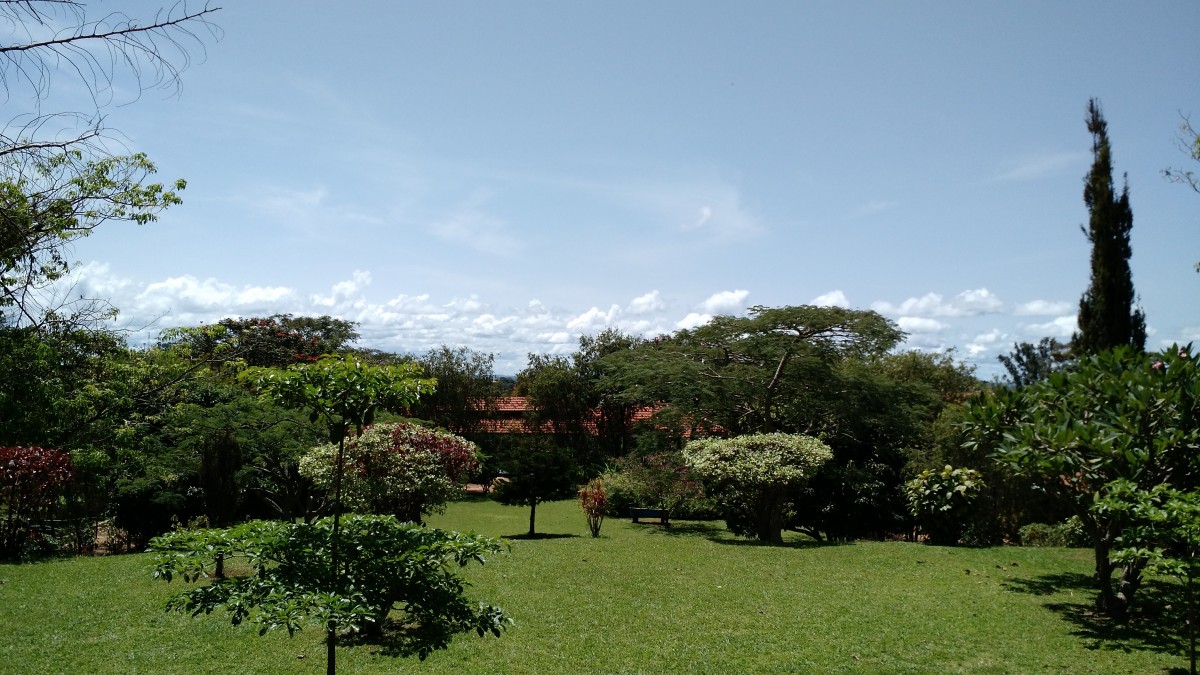
International School of Uganda’s campus
This week I started working at the International School of Uganda (ISU). I have been helping out Rita in the upper school (middle and high school) music classes. The classroom is a great example of the combination of musical styles in Kampala. There are shelves with guitars, flutes, clarinets, saxophones and trumpets alongside adungus, endingidis and a few drums.
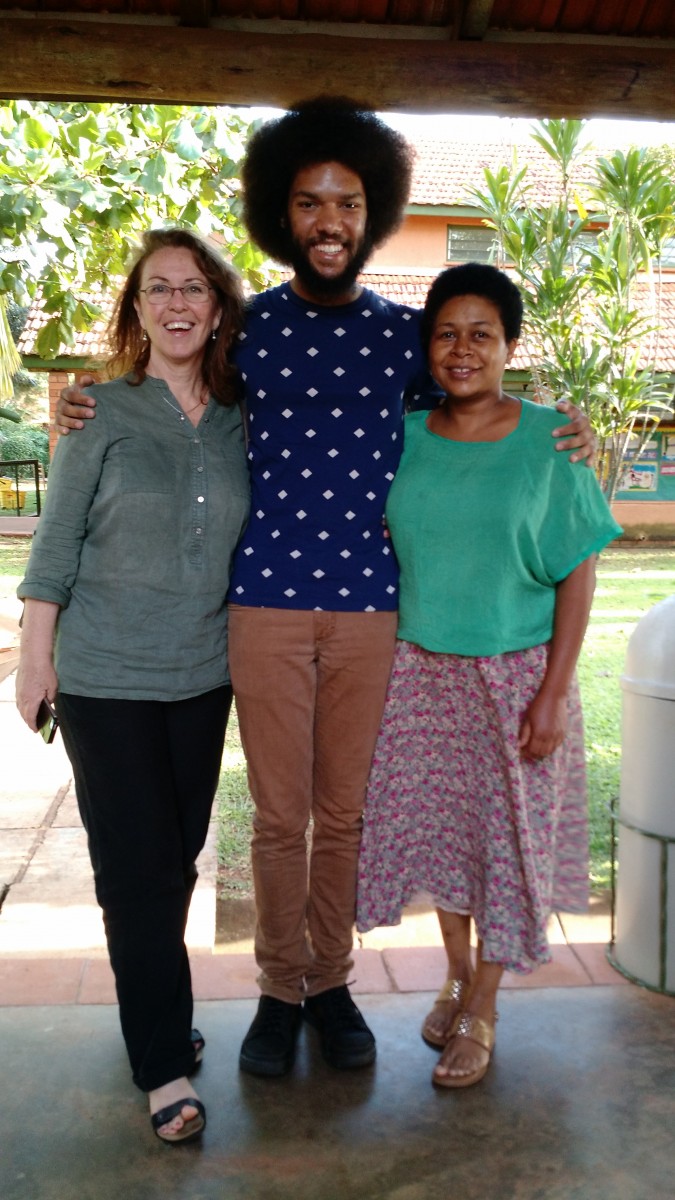
Me with two of my elementary school teachers!
On Thursday of this week, I accompanied Jill, one of the teachers at ISU, to Makerere University. In addition to working at ISU, Jill also teaches dance at Makerere. One of the interesting projects she is working on at the moment is a collaboration between her dance class at Makerere and the Norwegian College of Dance. They are putting on a performance on the 2nd and 3rd of May which I am planning to attend. She also does an annual collaboration with the dance department at NYU.
After she finished her class at Makerere, I went with Jill to In Movement where they were rehearsing for the Norwegian College of Dance collaboration. In Movement is an organization that provides arts education to youth in Uganda. On the same property is ’32º East: Ugandan Arts Trust.’ This organizations goal is to provide resources for the development of an arts community in Uganda. They have several artists in residence and have held several exhibitions throughout Kampala over the years. One of the exhibitions I found particularly interesting was a mobile exhibit called ‘The Boda Boda project.’ Boda bodas are motorcycle taxis that provide a significant amount of public transportation throughout Kampala and other urban centers in Uganda. The project featured 20 artists who each created an installation utilizing a boda boda. The exhibition then traveled around Kampala and was on display in different locations over the course of the 2014 Kampala Contemporary Art Festival.
After returning to the University campus I was able to make an appointment to meet with Professor Sylvia Nannyonga-Tamusuza next week. The week I have been reading the book Ethnomusicology in East Africa: Perspectives from Uganda and Beyond which she edited along with Thomas Solomon. The article Professor Nannyonga-Tamusuza contributed to the book is titled What is “African Music”? Conceptualisations of “African Music” in Bergen (Norway) and Uppsala (Sweden). In her study, she focused on how people in Bergen and Uppsala perceive music from Africa and music that is marketed as such. Part of her argument is that “the term ‘African music’ is a brand name, an economic (popularised by the media as commercial product), political, and academic construct” (Nannyonga Tamusuza 204). I interpreted her analysis as a response to the use of the term as way of commodifying musics from Africa as “homogeneous, original, traditional, authentic, romantic, exotic, simple and natural” (Nannyonga Tamusuza 206). I am going to explore some of the sources she cites in her paper and try to provide further insights into this topic.
While on the Makerere campus, I was also able to hear a performance by a class studying popular music. The played an array of American and Ugandan popular music including a cover of Cindi Lauper’s ‘True Colors.’
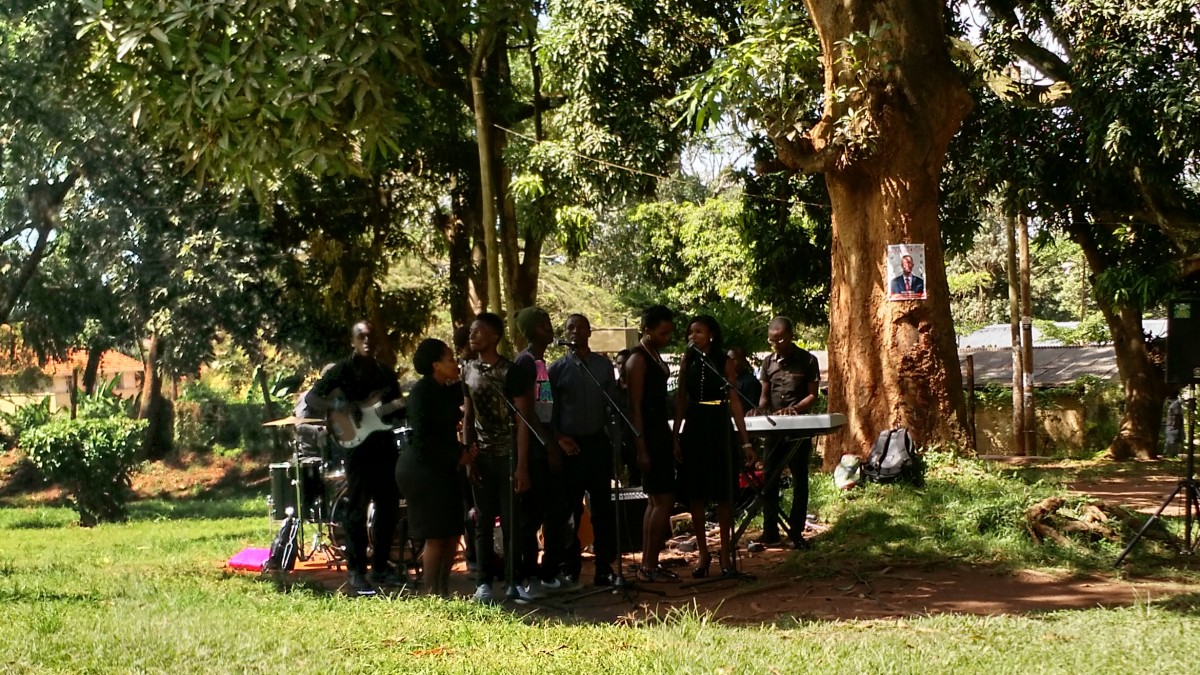
Makerere students performing on the lawn
I also made a trip to the Uganda National Museum. Fortunately the museum is pretty close to where I am staying so I was able to walk there. When I got there the first place I stumbled upon was the Library of the Uganda Society. The Uganda Society was “founded in 1923 as the Uganda literary and scientific society.” The librarian was extremely helpful and found a couple of books on Ugandan music for me. I spent some time looking over a book called African Music from the Source of the Nile by Joseph Kyagambiddwa. The book was published in 1955 so it is fairly old but had a lot of interesting information about Baganda music and had a rather large collection of scores and descriptions of the music. I am looking for a copy of the book online and will hopefully be able to find one that I can get back in the US. I also picked up a copy of Volume 53 of the Uganda Journal which is a publication released by the Uganda Society. There is an interesting article in this edition titled Music in the Sacred Forest of the Rwenzori by Vanna Viola Crupi. The article discusses how the Bakonzo people who live in the region relate to the environment through music and how this relationship has been altered by the designation of the Rwenzori mountains as a National Park.
After spending some time in the library, I made my way to the museum itself. One of the first exhibits I found was a display of the traditional instruments of Uganda. They had all the instruments arranged by type (drums, flutes, horns, bells, harps, etc.) and within each category they presented instruments from different tribes in Uganda. One instrument I am particularly interested in is the agwara from the West Nile region of Uganda. These trumpets are usually in a set of 7, each of which sound a different pitch. Each player plays a specific pattern which fit together to create a song. The Ndere Troupe played a song with the agwara at the performance I went to last week in which they broke the piece down into its individual components. Another really interesting instrument was a clay drum from the Bagisu of Eastern Uganda. I haven’t been able to find out anything else about it but I will continue digging.
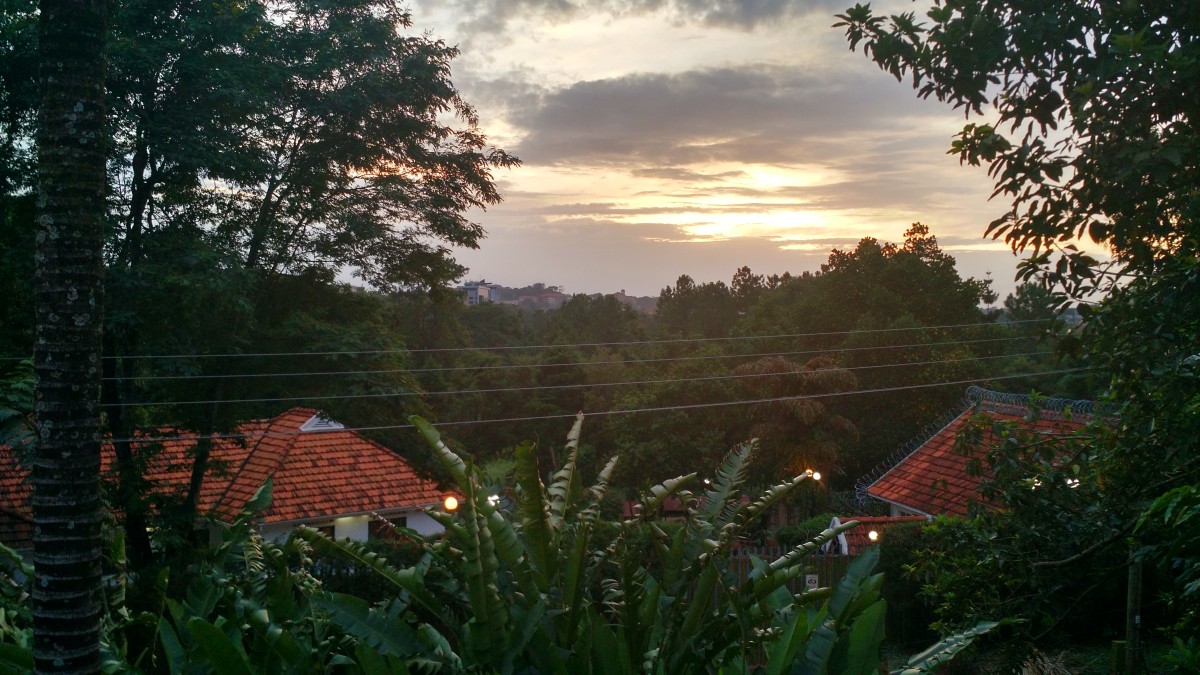
View from the balcony at dusk
This week I also made some additional observations regarding the soundscape. All over the city I had been hearing this wonderfully rhythmic hooo hooo hoo-oo hoo hoo that always made me want to dance. I was able to look through a book of East African birds that I borrowed from Cathy (the friend I am staying with) and discovered that it was the red-eyed dove that was making the call. I have been having difficulty getting a good recording of it but I will include one once I can.
I have also begun to hear, in addition to the roosters and other birds I hear every morning, a Muezzin calling for morning prayer from one of Kampala’s mosques. I’m not sure exactly where this mosque is but I’m sure I will stumble upon it while wandering around the area.
Here are a few songs that I have listened to over the past week:
Bwendifa – Ndere Troupe
Abedo kena kena – Ndere Troupe
Well here I am In Olmypia Washington trying to figure out what I’m doing with my travel arrangements and as I am sitting by the bay listening to the waves splash, and the birds speak, and the people playing I realize that I no longer felt as if I was at the bay enjoying the sun and the natural sounds scape but I had literally been transported to a point in my past of when I was child screaming an playing in the park back home. Remembering this meant that at that moment this familiar sound was actually triggering a moment in my past, making that very moment relatable to my present position. Except one small difference, that even though my mind was taken back to a place of familiarity that the experience I was having was still different. With out realizing every position of sound in and around us we all consistently making choices actually by the sounds we are hearing, weather or not it mentally registers or not, sound is energy that is moving and affecting us all in a physical way. This is where the idea of sound manipulation comes into affect, how corporations and even our own government take advantage of fear, happiness, sadness, and almost every emotional response that consumers can relate to. just like In one of the readings from winters quarter we talk about the city, how all cities seem to have similar qualities that remind a person of a city, that similarity still does not define the identity of every city. Tying that in my experience on the bay, Even though the feeling and experience was similar to that triggering moment from my past it still was not the same. So how do these large corporation draw consumers into buying or investing in said ideas, goals, or lifestyles if not every experience is the same? My theory is that the sounds that do not affect our minds due to exposure from multiple similar experiences/sounds then build stereotyped like muscle memory. Business use this Stereotyped “Sound” with in there advertising, film, and music, to portray an emotional response that these business are hoping most people will relate too. The thing though about these relatable triggers is that people do not tend to acknowledge that even though something about this piece of art is relatable and similar, the situations are not the same nor are they they in most cases real.
This all started with the coming of technology and large corporate mass media, also know as urban ethos’s. When Film first became popular it was entertaining by means of being in a quiet room watching black an white screen with subtitles and large facial expressions, until music was added to silent films as a way to portray sounds and emotional responses to the body language of said characters and scenes. As soon as sound hit the screen it changed the very art of film, there is a saying; that, that day film it self as an art died. relating this to programed music and absolute music to film, absolute film would be film itself, when it was silent, then there is programed film, this is where film no longer is just a silent film, but is using sound to help portray the meaning of the story by using sound to emulate the meaning of the films original story.

This is a picture of the capital building at night, not many people see this but late at night when its dark out the capital building has lights on it. There is a lighting design on the building that actually makes the capital building look like there is a giant smily face on it. When I see this at night I think about the artist who took the time to do the lighting for this building and what there intentions as a light designer was when they put the lights on the building, or did they even know that this would happen? Either way, I look at what this building, what it represents and where it is located. Only in one of the most open, liberal places in this country would have a lighting designer create a shadowed smily face on our states capital building.
I think the notion of time passing has been so interesting to ponder. The idea of observing myself and what my day-to-day routine looks like has always seemed interesting to me, but to observe your own behavior for weeks on end isn’t easily accomplished. These posts seem to give me a sense of footing within the amplified sensitivity to chaos my mind’s been going through as a result of traveler’s anxiety these past weeks. So hopefully in writing this post, I will achieve some clarity as to what I’m really thinking.
I tried to spend this week less concerned with seeing what the city has to offer, as a brochure might read. I focused my energy more towards my readings, as well as finding examples in real life of the ideas presented in the book. I still made sure to get outside and go places, as it would be foolish not to take advantage of my time here and do things specific to being in L.A. I did a lot this week, and it definitely got me thinking… But I’ve got to be honest, it’s tough articulating all of it. And though I see similarities and am making connections between different ideas, I’m unsure how to properly and clearly connect them in this text.
Last Wednesday I was in the Design District on Melrose Avenue. I was there for a few different reasons. Though the hipsters in my neighborhood are very interesting to observe both socially and with regard to fashion, I wanted to see if I could go somewhere that would show L.A. fashion. I’ve since reexamined that thought, as Los Angeles is so disconnected that nothing besides clothing suited for the weather could really encompass all of this city. Nevertheless, I wanted to see the design district, as I love clothing and design. I’ve seen three main ways that high-end clothing is being sold here, the 1st being department stores, 2nd being brand-storefronts and the third being boutiques. Sunset Boulevard is about a ten-minute skate from my house, and it has quite a few small boutiques. The design district had lots of brand storefronts.
Just going into these stores is fun for me. I love going inside and looking through stuff way to expensive for me, just because they can’t tell me to leave. The real reason I found myself in that area though, was because of a video I watched on Complex magazine’s website. Shopping with A$AP Rocky. The video is from a series where someone from the magazine goes shopping with a rapper for shoes, but A$AP Rocky said he didn’t want to go sneaker shopping, and instead he took them to a high-end boutique in Los Angeles called Maxfield. I found the boutique online, and the website said they sold clothing, furniture, and vintage fashion, architecture, art, and music books. I figured even if I can’t afford $1,000 jeans, maybe I could get a book. I parked about a mile and a half away so I could walk down Melrose and just look at all of the shops and people. When I got to the place Google maps took me, all I saw was an almost empty valet parking lot, and a concrete building that looked like a starving travel agency. I looked across the street and saw a building that read Maxfield. It had all glass windows, and weird looking furniture inside, furniture that looked like sculptures. I walked to the door and saw a sign that said, “Ring Door Bell.” I didn’t want to ring and have some furniture salesmen come over, so I just opened the door. It was giant and wooden, kind of heavy but it opened super smooth. A lady came fast pacing around the corner and asked me “Hello?”
“Hey do you guys have books here?” I asked.
“It’s the other building, across the street.”
I asked if she would point it out because I couldn’t find it, but she cut me short, saying “there’sonlyonebuilding. it’soverthere. see!?”, she pointed across the street, her arm resembling someone who probably loves Hitler. I left.
I walked to the other side again, this time I spotted a Rolls Royce in the driveway of the parking lot. I walked over to what I thought was originally a tacky travel display, and realized it was actually art. I walked around the corner, following a tentative polished concrete path. I saw the doors and went inside. I was greeted by the usual friendly suspicious retail “Helllloooooo”. I asked for the books and headed to the back, where the salesman pointed. A saleswoman with an eastern European accent came over shortly and asked if I needed any help. As it turns out, the books were also thousands of dollars. Luckily they had some less-expensive, non-vintage books, one of which I bought.
On my walk back to my car, I got a call from Konstantine Valissarakos. He’s a family friend who works real estate down here. He restores vintage homes and sells them to L.A.’s affluent. I’d been waiting to get an interview with him for about a week. He said he was coming home from work a bit early, so we arranged to meet at his house at 6:15. On the phone, I mentioned that I’d just bought a book on fashion, and he told me he had a biography on Vivenne Westwood, and though he’s a huge fan he wasn’t going to read it and he said I could have it. I was stoked! He called me at 4:38. According to my phone, I was 15 minutes from home and home was 10 minutes from Kostantines house. But I went straight from there to my house, grabbed my notebook, left for his house immediately and didn’t get there until 6:20. On the phone, he said that he lived beneath the Hollywood sign. As I got closer, I came upon an incredibly narrow, steep, windy road. It was so narrow that I would have to back up the whole thing if another car came. Luckily I found his place and parking was easy enough. The roads were narrow, clean, with high walls on either side, broken up by tall shrubs, gates, and fences. I found the address, which led to another tall wooden door (my second finding of a tall wooden door that day). I tried to open the door but it was locked, and I couldn’t figure out how the buzzer worked. Eventually he came and opened the door.
If I met Kostantine when I was young, I still didn’t remember how he looked. His parents were good friends with my grandparents, and my grandma had connected him and I via email. I just knew that I’d heard about what he did, thought it was cool and wanted to be able to talk to him. We went inside and he handed me the Vivienne Westwood book, as well as some food wrapped in Tin Foil, it was his mother’s Greek Easter bread. He gave me a tour of the house. It was 2 and ½ stories. His living room had an amazing view of Los Angeles, and his house was filled with many relics, all of which had a backstory. There was a large shoe parking lot right at the entrance. It was an interesting arrangement, everything from high tech runners to loafers, tons of shoes. I asked if all of them belonged to him, he told me no but he just grabs whatever is fastest in the morning. After the tour I interviewed him for about 45 minutes and recorded the conversation. It’s hard to process everything I learned from Kostantine, but what I saw was a valuable experience.
We sat down, and I started by asking him when he came down to Los Angeles. He told me about a few of his first sales, but the conversation quickly became more conceptual. He was a good conversationalist, he seemed like someone who means everything he says, 100%, and it’s hard to convey the weight of what that was like through words alone. His younger years were spent in Wenatchee, my hometown. From the time he was eight years old, he was working in his parents restaurant, which was noted by my family as being both extremely hospitable and very well decorated. He sold his first house before he graduated from college, and eventually moved down to Los Angeles. He was fearless, and jumped right into his work at a young age. He now works with Sotheby’s and has an impressive list of houses he has completed and is still working on. He was wearing athletic shorts and a t-shirt, and told me that’s what he wore to work everyday. I could tell from our conversation that Konstantine must be great working in such a people profession. But I couldn’t have anticipated what he was like, aside his job. What I learned though is that he is his job. Sothebys is his company, but he’s his own brand. Konstantine described something to me he calls “creative capitalism”. In essence, wanting to make a lot of money but doing so completely honestly. The reason he goes to work in shorts and a t-shirt is because his branding says what you see is what you get. As he puts it, that’s how confident he is in the houses he sells, that he shouldn’t have to wear a suit or drive his clients in a $100,000 car. Konstantine says this branding of values is something he got from growing up and working for a small business in Wenatchee, which he describes, to my accord, as the complete opposite of Los Angeles. What I find so interesting is that while his clientele may be like the people I saw on Melrose Avenue, he isn’t concerned with an incorrect image, only a truthful image, as he puts it. Image still matters, but it needs to speak to something honest. In his case, it speaks to the way he does business.
Over the next week I read the Vivienne Westwood Biography. Prior to this trip, on my reading list was a biography of Malcom Mclaren. What I didn’t know until reading this book is that Vivienne Westwood played a critical role in the Malcom Maclaren Story (emergence of punk, sex pistols, etc.). Vivienne Westwood was heavily responsible for punk, she designed all of the clothing for the sex pistols, and had a high-end boutique called Sex. She’s 74 now, still working “as hard as the interns”. According to the biography, punk is the first popular music movement to have fundamental roots in high fashion designs. Vivienne designed the image of what came to be known as punk. Co-Author Ian Kelley noted the most unique thing about Vivienne being the childlike enthusiasm and energy she has managed to sustain up to age 74, still pulling consecutive all-nighters during Paris fashion week and living off of apples and tea.
I came down here wide eyed (still wide eyed), wondering how I could connect the dots between music I love, clothing I love, and people making all of that happen. Being in L.A. personifies the way MTV might paint the young American’s dream—flashy clothing, flashy cars, and the luxury of isolation. It makes me feel like a dot in such a big city, and ultimately I find myself questioning why I ever wanted to do the things I want to do. Everyone here looks like an artist and everyone wishes for that dream. I think so many people must seek success because of what they see around it, almost all of what that catches their attention being something they don’t have. But many successful people I’ve met and talked to don’t seemed concerned with things surrounding them. There are for sure rich asinine people, but the people we know who did truly great things don’t live forever in the moments witnessed and envied by everyone else. So why would it make sense chasing success for the things I see around success, when the most successful people I’ve met don’t seem concerned with that at all. It reminds me of the saying, “don’t follow the footsteps of the greats, seek what they sought.” If one wishes to achieve success with anything, it doesn’t make sense to chase the things surrounding it. As I experienced with Kostantine, having expensive things doesn’t make you important.