
There are in our existence spots of time,
That with distinct pre-eminence retain
A renovating virtue, whence—depressed
Or aught of heavier or more deadly weight,
In trivial occupations, and the round
Of ordinary intercourse—our minds
Are nourished and invisibly repaired;
A virtue, by which pleasure is enhanced,
That penetrates, enables us to mount,
When high, more high, and lifts us up when fallen.
-from The Prelude by William Wordsworth
Alain de Botton highlights the preceding section of The Prelude by William Wordsworth in The Art of Travel. De Botton explains that “we may see in nature certain scenes that will stay with us throughout our lives and offer us, every time they enter our consciousness, both a contrast to and relief from present difficulties. [Wordsworth] termed such experiences in nature ‘spots in time’” (de Botton 151). I have a vague memory of one such spot in time from when I still lived in Uganda. I was about 5 years old and I accompanied my father on a work trip. On the way we stopped by a section of rapids in the Nile and I can still recall that image (although probably embellished by time) of the swiftly moving waters.
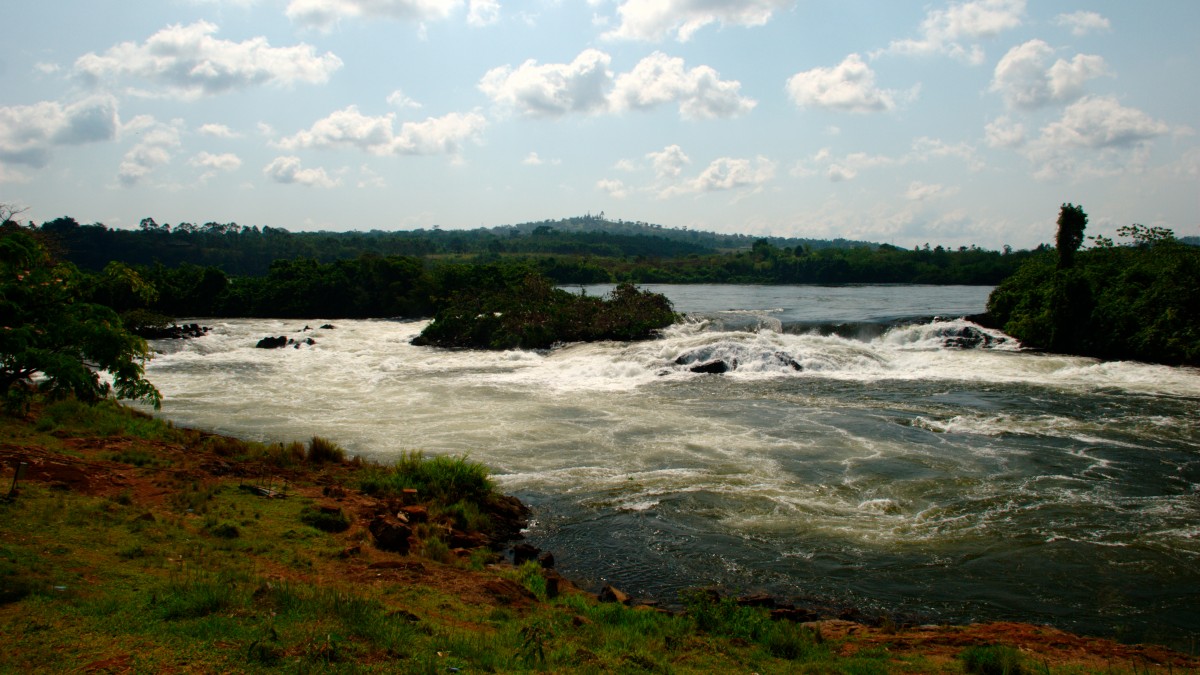 Bujagali Falls, Uganda
Much like nature, music has the ability to create these ‘spots of time.’ We often use music as a means of communicating a message where words would not be sufficient to convey our true meanings and intentions. Wordsworth wrote to a student in the summer of 1802 that “’a great Poet…ought to a certain degree to rectify men’s feelings…to render their feelings more sane, pure and permanent, in short, more consonant to Nature’” (Wordsworth qtd. de Botton 145). I have often found music and dance to have a similar effect on me.
Wordsworth proposed that nature could “dispose us to seek our in life and in one another ‘whate’er there is desirable and good’” (de Botton 144). I have often found this to be true. Spending time in the forest usually allows me to clear my mind of much of the clutter that often develops when I am steeped purely in urban life. I wonder what the results would be if we were able to make our urban environments more harmonious with the natural environments that surround them. I am inclined to believe that this would help improve both the living conditions within the city as well as the creative capacity of the city’s community.
De Botton states that “if we are to accept (even in part) Wordsworth’s argument, we may need to concede a prior principle holding that our identities are to a greater or lesser extent malleable, changing according to whom—and sometimes what—we are with” (de Botton 145). This is another claim that my personal experience (although I do not wish to claim that my experiences speak for everyone or even anyone else) seems to corroborate. The people we spend time with, the music we listen to, the visual art we see, among the many other interactions we encounter in our lives all have an effect on our identities and the way we perceive the world.
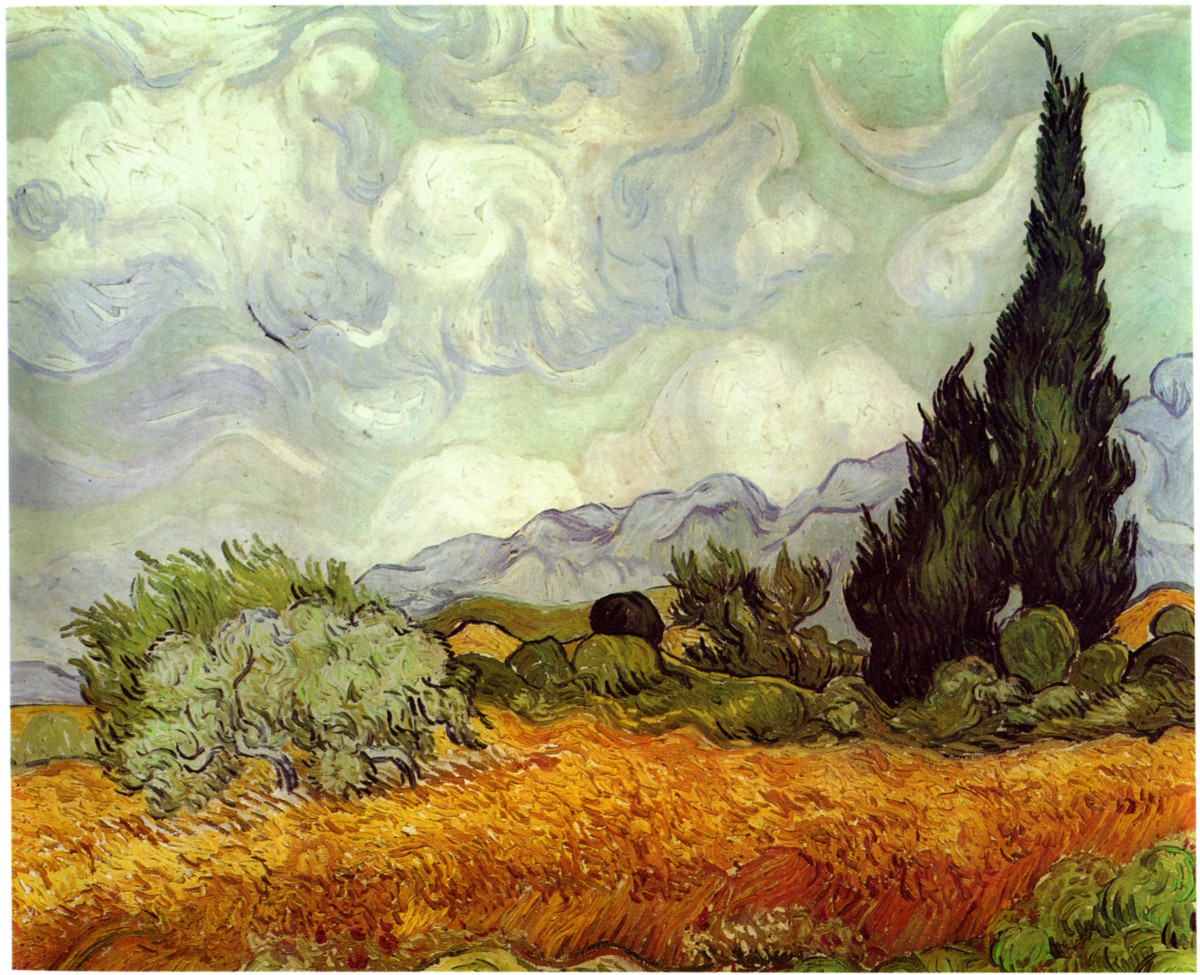 Wheat Field with Cypresses by Vincent van Gogh
De Botton also discusses the ways in which Vincent van Gogh was able to change perceptions of a place through his artwork. By selecting the features he accentuated in his paintings, van Gogh was able to draw the attention of the viewer to those aspects of a scene which he connected to the most. This in turn has made viewers of his artwork more receptive to similar scenes in the natural world. De Botton goes on to say that “art cannot single-handedly create enthusiasm, nor does it arise from sentiments of which nonartists are devoid; it merely contributes to enthusiasm and guides us to be more conscious of feelings that we might previously have experienced only tentatively or hurriedly” (de Botton 209). Experiencing works of art can help open our eyes to new ways of looking at the world.
While I am in Kampala I hope to explore some of the ways in which the art created there inspires new ways of seeing. In addition to the time I spend in the city, I am going to spend some time in the many natural landscapes of Uganda. The works of art I see in the city will help inform the way I view the natural landscapes and in return the natural landscapes will help inform the way I experience the works of art.
I want to end this post with one of my favorite poems by Wordsworth:
The world is too much with us; late and soon,
Getting and spending, we lay waste our powers;—
Little we see in Nature that is ours;
We have given our hearts away, a sordid boon!
This Sea that bares her bosom to the moon;
The winds that will be howling at all hours,
And are up-gathered now like sleeping flowers;
For this, for everything, we are out of tune;
It moves us not. Great God! I’d rather be
A Pagan suckled in a creed outworn;
So might I, standing on this pleasant lea,
Have glimpses that would make me less forlorn;
Have sight of Proteus rising from the sea;
Or hear old Triton blow his wreathèd horn.
Works Cited:
Botton, Alain De. The Art of Travel. New York: Pantheon, 2002. Print.
Wordsworth, William. “The Prelude.” The Complete Poetical Works. London: Macmillan and Co., 1888; Bartleby.com, 1999. www.bartleby.com/145/. 4/7/2015.
Wordsworth, William. “The world is too much with us.” The Complete Poetical Works. London: Macmillan and Co., 1888; Bartleby.com, 1999. www.bartleby.com/145/. 4/7/2015.
Image Sources: