In 2018, Dr. LeRoy was awarded a grant from the National Science Foundation to study the influence of plant genetics on in-stream ecosystem function. The title of the grant is: “How genetic variation in riparian trees influences stream succession and ecosystem function.” Research updates were posted on Twitter @CarriLeRoy and under hashtags: #MountStHelens, #SURFevergreen, #wundergrads (until Oct. 27, 2022).
Press related to this research:
- 2023 Dr. LeRoy was named a 2023 River Warrior by the Lewis Pugh Foundation
- 2022 Former undergraduate, Iris Garthwaite finishes Masters degree at Northern Arizona University, and is awarded both an NSF Graduate Research Fellowship and a Presidential Management Fellowship!
- 2021 Dr. LeRoy was awarded the Presidential Award for Excellence in Science, Mathematics, and Engineering Mentoring by the White House Office of Science, Technology, and Policy and the National Science Foundation.
- 2020 article in The Daily News highlights our stream ecology research
- 2020 article in Thurston Talk highlights collaborative work with undergraduate students
- Articles about potential road-building on Pumice Plain in L.A. Times, High Country News, The Daily News, Centralia Chronicle, Seattle Times, and Columbia Insight
- TV broadcast including our outreach with middle school girls through GeoGirls.
Research update: June 30, 2023
We just closed out our 5-year long study at Mount St. Helens, are wrapping up all of our grant details, and submitting our final reports! We worked with over 36 undergraduates at Evergreen and beyond, and collaborated with four graduate students at Missouri State University, Georgetown University, Oregon State University, and Washington State University-Vancouver. We collaborated with the US Forest Service, Desert Research Institute, George Mason University, and the Center for Urban Waters at the University of Washington-Tacoma.
We published 16 papers supported by this grant since 2018 with nearly 40 undergraduate co-authors in journals like: Freshwater Biology, Ecosphere, Fundamental and Applied Limnology, Hydrobiologia, Ecology & Evolution, Forests, and Aquatic Sciences. Find links to these articles here.
Research update: February, 2022
At the end of the year, we published an article on the influence of willow catkin inputs on stream communities and processes in Fundamental and Applied Limnology (Garthwaite et al. 2021). This article was led by our former undergraduate research assistant, Iris Garthwaite. Iris completed her Masters degree at Northern Arizona University! Congrats Iris!
Another undergraduate led papers was published in the Oregon State Arthropod Collection Journal (Kamakawiwo’ole et al. 2022). We are working to submit an article on willow leaf chemistry to the journal Oikos (Ramstack Hobbs et al.), and another paper on the influence of willow canopy cover on stream communities and ecosystem processes to the Canadian Journal of Fisheries and Aquatic Sciences (LeRoy et al.). [UPDATE: both of these papers have been published! Ramstack Hobbs et al. 2022 and LeRoy et al. 2023]
Collaborative Artist Book Release: November, 2021
Visit the Science Stories website to see the new collaborative book created by Mari Eckstein-Gower in collaboration with PI LeRoy. It is titled “The Willow and the Mountain” and describes the 1980 eruptions and the primary successional landscape as it changes through time. The images are vivid and full of movement! The book is part of an exhibit at the Collins Library at the University of Puget Sound this winter.
Research update: September, 2021
We are working hard to wrap up all of our projects, and get our papers published. We published our first articles for the project. The first is a paper that explores the spatial distribution of male and female willows along streams on the Pumice Plain of Mount St. Helens, and the influence of plant sex on litter chemistry and decomposition in Ecosphere (LeRoy et al. 2020). The second paper explores broader patterns in communities of algae, macroinvertebrates, and riparian plants across five 40-year old watersheds on the Pumice Plain in the journal Freshwater Biology (Claeson & LeRoy et al. 2021).
Research update: September, 2020
Well, six months into a global pandemic, we are all trying to get as much done as we can, given the circumstances! Our lab has been closed since March 2020. Our ability to get into the field has been limited to only a couple short trips, but we are making major progress on various aspects of our research program from home. Several of us have set up “home labs” with microscopes to work on aquatic insect identification. We are making major headway on several manuscripts, and got two papers in review this summer. We’ll keep on, keeping on!
Research update: December, 2019
Fall quarter involved an extensive focus on lab work with a nice big group of eight (8) “wundergrads.” Undergraduates at Evergreen can spend up to 40 hours per week doing research collaborating with faculty. Students took the lead on freeze-drying and weighing leaf litter from litterbags, weighing and testing the tensile strength of canvas strips that were incubated in streams across the Pumice Plain, sorting and identifying macroinvertebrates from litterbags, and coordinating the grinding and and analysis of carbon, nitrogen, and condensed tannins in the leaf litter.
Research update: September, 2019
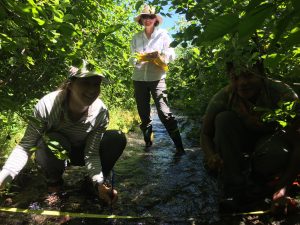
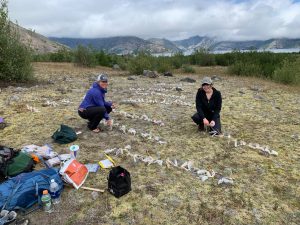
We had an excellent summer field season at Mount St. Helens. We surveyed over 300 willow trees for leaf modifying community members (endophytes, weevils, galling midges, galling sawflies, and tent caterpillars) and the influences of plant sex on each organism. We collected summer-fall leaf litter and have filled hundreds of leaf litter bags to compare summer vs. fall litter and male vs. female litter decomposition rates. Evergreen undergraduate Victoria C. is shown below helping install litterbags and her own pumice bags on the Pumice Plain with Research Scientist, Joy Hobbs.
STEM Outreach programs
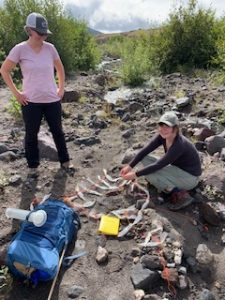
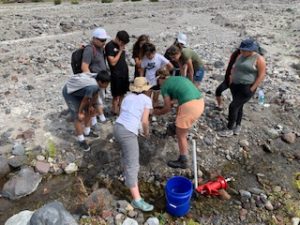
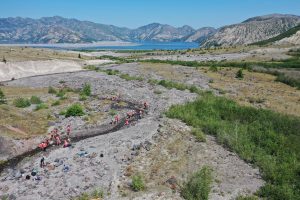
Outreach programs allowed us to spend time with high school students, middle school girls (GeoGirls), and Upward Bound students from Vancouver, WA.
GeoGirls was included on local TV KGW8 on
Media Outreach
We spent a day with reporters from the Longview Daily News – Chloe Skaar and Courtney Talak. Dr. Deb Finn from Missouri State University made many trips to Mount St. Helens and was a great mentor to Evergreen students! The article was posted in The Daily News on May 14, 2020. Sex and the Volcano: Researcher Learns Nature Favors Females in New Creeks.
Wide Collaborations
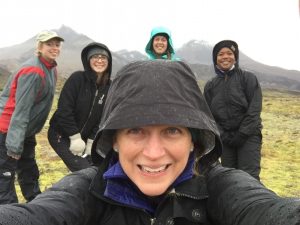
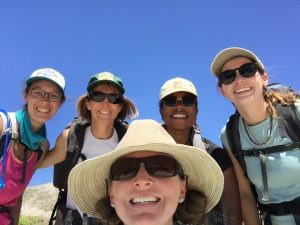
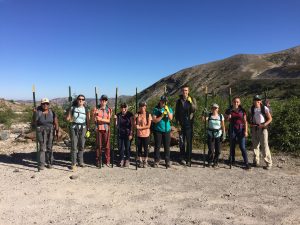
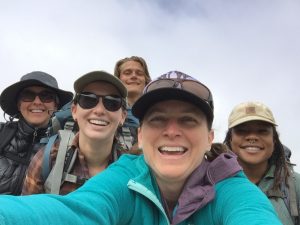
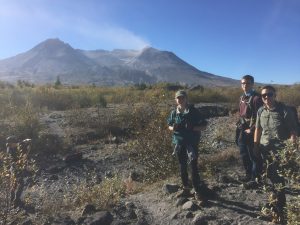
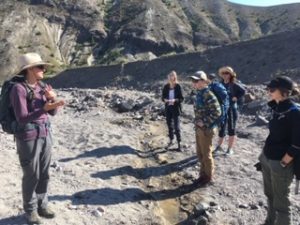
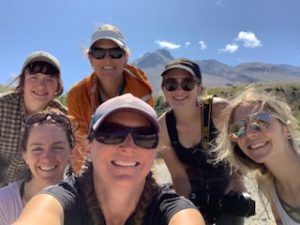
Photos below show collaborators, Shannon Claeson (USFS) and Joy Hobbs (Science Museum of Minnesota), along with many Evergreen undergraduates; Lauren Walker from Lewis & Clark College, and Emily Wolfe a PhD student at Portland State. Special thanks to Jordan Moffett, Evergreen graduate 2019 for being our Science Specialist July 2018-March 2019.