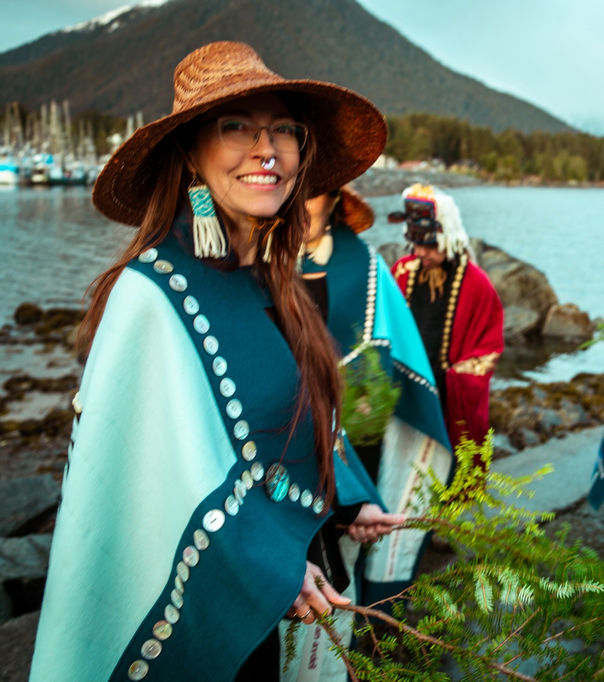
Xéetl’ee Katelyn Stiles is an artist and scholar working in the mediums of movement, film, drawing, and community-based research creation. Katelyn is Lingít, of the Kiks.ádi Clan (Raven/Frog) and Kaxátjaa Hít [Shattering Herring House] of Sheet’ká [Sitka, Alaska], and a citizen of Sitka Tribe of Alaska. Her ancestors are also Norwegian, English, and French settlers. Women of her clan are known as Kax̲átjaashaa [Herring Ladies] and this responsibility is central to her work.
Her creative community-based research centers the rematriation of Herring Lady embodied protocols with Yaaw [Pacific Herring] to co-create ecosystems. Her work crosses into critical Indigenous Studies, Improvisation and Performance Studies, and Feminist Science and Technology Studies, focusing on embodiment and relationality to land, water, the more-than-human, and technology. Movement is central to her work and she has danced professionally in different contexts. She also lived in Berlin, Germany for several years, where her film work was screened internationally in film festivals. Her recent projects include the film Yee eedé tooshí áa [We sing to you] and the creation of the Herring Lady and Shame Robe Dance, both collaborations with Ḵ’asheechtlaa Louise Brady and Herring Ladies.
Katelyn holds a PhD and MA in Native American Studies with a designated emphasis in Performance and Practice from the University of California, Davis. She also received a BA in Art Practice from the University of California, Berkeley. She currently works as an Assistant Professor of Indigenous Arts at Evergreen State College, and previously taught Indigenous Studies at the University of Alaska Southeast in Sheet’ká.
Wendy Red Star is an artist living and working in Portland, Oregon. Red Star received her B.F.A. from Montana State University-Bozeman and her M.F.A from UCLA in 2006. She has exhibited both nationally and internationally. Her exhibitions include shows at the Fondation Cartier pour l’Art Contemporain, Hallie Ford Museum, The Eiteljorg Contemporary Art Fellowship 2009, Utah Museum of Contemporary Art, Missoula Art Museum, St. Louis Art Museum, National Museum of the American Indian-New York, Portland Art Museum, Minneapolis Institute of Arts, Indianapolis Museum of Contemporary Art, Metropolitan Museum of Art, Bockley Gallery, and Haw Contemporary gallery. She has been a visiting lecturer at a range of respected institutions, including The Banff Centre, CalArts, National Gallery of Victoria (Melbourne), Portland State University, Dartmouth Hood Museum, Figge Art Museum, Fairhaven College, Fine Artworks Center-Provincetown, and I.D.E.A. Space-Colorado College.
JOHN FEODOROV
Born in Los Angeles of mixed Navajo (Diné) and Euro-American heritage, John Feodorov grew up in the suburbs of Southern California while making annual visits to his family’s land near Whitehorse, NM. The time he spent with his mother and grandparents on their homestead near the Anasazi ruins at Chaco Canyon continues to inform and impact his work.
John has been called a conceptual artist, a political artist, as well as a Native American artist, but he is still not sure how to define what he does. His work includes painting, drawing, assemblage, installation, video, music and songwriting. He also has engaged in experimental performance in the past, but not lately. Currently, he writes and performs with his art/pop band, The Almost Faithful.
John’s work as been widely exhibited and has been featured in several publications; most recently in Time and Time Again, by Lucy R. Lippard, and Manifestations, edited by Dr. Nancy Marie Mithlo. He was also featured in the first season of the PBS series, “Art 21: Art for the 21st Century”.
John has also worked with the Seattle-based afterschool arts program, Artscorps, and served as an Arts Commissioner for the City of Seattle. He is currently an Associate Professor of Art at Fairhaven College.
SARA SIESTREEM
Sara Siestreem (Hanis Coos and American, 1976-) is from the Umpqua River Valley in South Western Oregon. She grew up in Portland, Oregon. She is a Master Artist and Educator. She comes from a family of professional artists and educators and her training in both fields began in the home. Siestreem graduated Phi Kappa Phi with a BS from PSU in 2005. She earned an MFA with distinction from Pratt Art Institute in 2007. Siestreem is the weaving student of Greg Archuleta, Greg Robinson, and Nan MacDonald. She is represented by Augen Gallery in Portland and her work has been shown in museums and figures in prestigious private and public collections nationally.
Her studio work is multi-disciplinary. Her primary language is painting, but she also works in photography, printmaking, drawing, sculpture, video, and traditional weaving.
She teaches Foundations in Studio Arts and Indigenous Studies at PSU and Traditional Weaving Practices for The Confederated Tribes of Coos, Lower Umpqua, and Siuslaw Indians. She works as a consultant and free lance educator for museums and cultural groups regionally. Siestreem also serves various youth organizations and individuals in the role of mentor, workshop leader, promoter, public speaker and volunteer.
She lives and works exclusively in the arts in Portland, Oregon.
CORWIN CLAIRMONT
Corwin (Corky) Clairmont is a contemporary artist and enrolled member of the Confederated Salish and Kootenai Tribes. Living in Los Angeles, Corky pursued a contemporary exhibiting artist career as well as teaching and becoming department head of printmaking at the Otis/Parsons Art Institute located in Los Angeles, Ca. Upon his return to Montana in 1984, Corky began administrative work at the newly credited Salish Kootenai College located in Pablo, Montana on the Confederated Salish and Kootenai Reservation. This included the creation of the SKC Fine Arts Department and art degree program. Through work as a printmaker, conceptual and installation artist, Corky’s images discuss and explore situations or issues that effect tribal people such as sovereignty, colonization, giving a cultural and historical perspective. Corky’s artwork has been exhibited through out the United States and in several Countries including Germany Norway, New Zealand, France, and most recently at the US Embassy located in Kinshasa, Democratic Republic of Congo, Africa. Awards have included Ford and National Endowment of the Arts, the Eiteljorg Fellowship Award, and the 2008 Montana Governors Award for Visual Arts. He currently serves on the State Board of the Montana Arts Council.
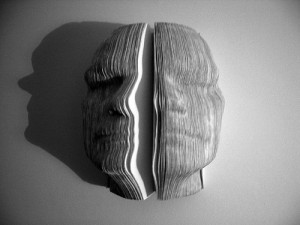
Born in Sitka, Alaska, Nicholas Galanin has struck an intriguing balance between his origins and the course of his practice. Having trained extensively in ‘traditional’ as well as ‘contemporary’ approaches to art, he pursues them both in parallel paths. His stunning bodies of work simultaneously preserve his culture and explore new perceptual territory.
Artist Statement 2010
I work with concepts, the medium follows. In the business of this “Indian Art World” I have become impatient with the institutional prescription and its monolithic attempt to define culture as it unfolds. Native American Art can not be commonly defined as our work moves freely through time. The viewer, collector, or curators’ definition will often convey more about themselves than that of the “Native Artist”. In the past I have struggled with this title, though I now embrace my position as a contemporary indigenous artist with belief that some forms of resistance often carry equal amounts of persistence. My current collection of work presents visual experiences in hope of inspiring creative dialogue with the viewer. I work with an intention to contribute towards contemporary cultural development. Through education and creative risk taking I hope to progress cultural awareness both in and out of this Indigenous world.
His work is in the current exhibition, It’s Complicated – Art about Home at the Evergreen Gallery.