The Evergreen State College

Tag: Native American Art

Week 8 – Gail Tremblay’s panel of Indigenous Basket Makers

Out of retirement to teach the first ever class from the new Fiber Arts Studio, Gail Tremblay has assembled a brilliant group of master weavers  for you!
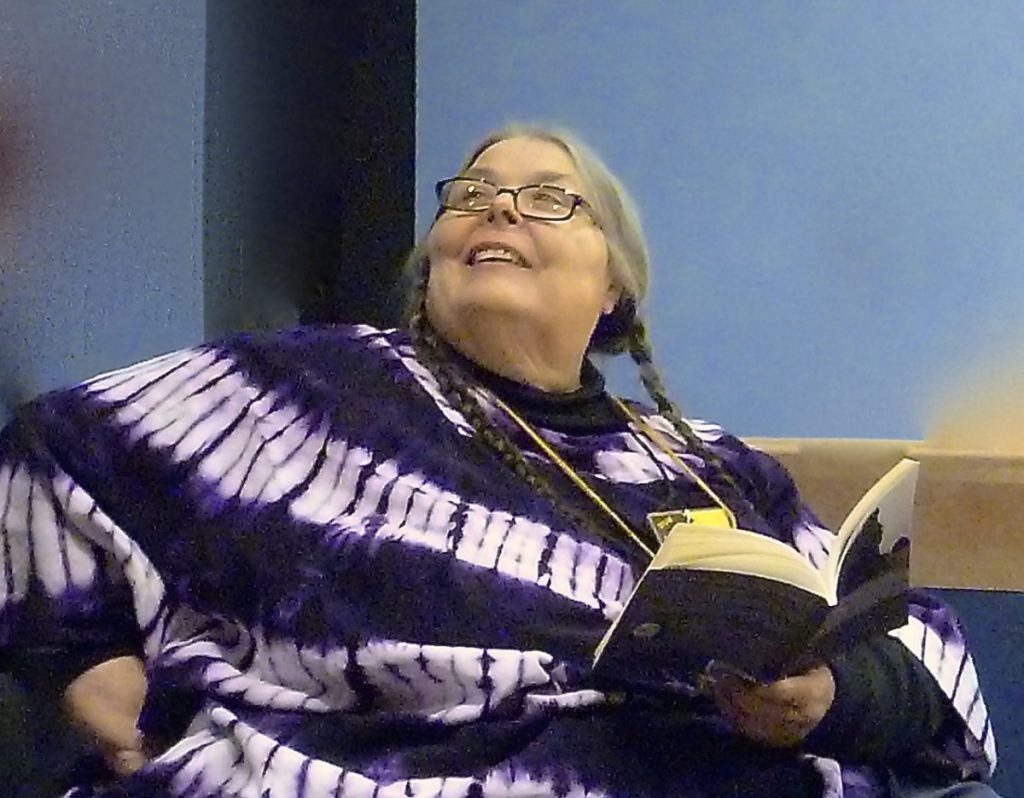
GAIL TREMBLAY
Writer, teacher, and mixed media artist Gail Tremblay (Onondaga and Mi’kmaq),was born in 1945 in Buffalo, New York.   Tremblay taught English, Native American Studies, Art, and Art History at Evergreen State College in Olympia, Washington, where she joined the faculty in 1981.  As an educator, she has influenced more than a generation of Native and non-Native students and has been instrumental in building Evergreen’s focus on Native arts and Native Studies.

In the 1980s, while she was teaching a Third World and Feminist Film Theory class, Tremblay began weaving baskets out of scrap 16mm film, old movie trailers, and outdated educational films. In perfect postmodern irony, Tremblay, who has been making baskets since childhood, utilized materials from a medium that often originated and propagated stereotypes of Indigenous people in order to create “traditional” baskets that critique those same stereotypes. Her titles often allude to the film source, which is frequently obscured by the weaving.

JOE FEDDERSEN…former Greener faculty member!

Joe Feddersen, who is Okanagan from the Colville Confederated Tribes, lives on the reservation in Omak, Washington.   He taught art programs, from the early 1990’s until he retired, at the Evergreen State College. His work includes a suite of what he calls his Urban Indian baskets that use designs from things like car and truck tire tracks, electrical towers, parking lot designations, and other forms, objects, and structures that have moved from urban America onto American Indian reservations during the 20th and 21st centuries.  Many non-Indian viewers often perceive his basket as having traditional Indigenous designs until they read the basket titles and come to see what he is saying about contemporary experiences in the Indigenous

JEREMY FREY

Jeremy Frey started weaving in his 20s, learning to make baskets from his mother Gal Frey. Gal taught him, drawing on what she had learned from her teacher Sylvia Gabriel. Sylvia was renowned for her basketry, especially her porcupine curlwork.  Jeremy learned all aspects of the tradition from selecting brown ash to pounding and preparing basket stuff. His work fuses traditional shapes with the innovative use of both traditional and non traditional materials, as well as unique signature designs.

Jeremy was born in 1978 and raised in Indian Township. His work has received national recognition with the 2011 Best of Show award at the Heard Museum Guild Indian Fair and Market and the Santa Fe Indian Market. He was the recipient of a $50,000 United States Artists grant.

TERROL DEW JOHNSON

Terrol Dew Johnson started basketry weaving at the age of ten. He soon learned that he was a born natural and found that it was one of the few things in life that he found intrinsically effortless.

Johnson is a member of the Tohono O’odham nation of southern Arizona. The Tohono O’odham have a long history of basket weaving using a whole variety of techniques using natural materials and dyes. These are all used in order to tie the basketry in with the local landscape colours and flora, making the baskets part of the community and of the larger landscape.

The traditional basketry weaving techniques that Johnson learnt at such an early age, have allowed him to expand into the world of contemporary fine art basketry, while still keeping hold of his traditions, which he uses as a foundation or anchor point for his subsequent career as an artist.

LISA TELFORD

Lisa Telford (Everett) was born in Ketchikan, Alaska, in 1957. As a Gawa Git’ans Git’anee Haida weaver she comes from a long line of weavers including her grandmother, mother, aunt, cousins and daughter. Lisa harvests and prepares her own material, using red and yellow cedar bark and spruce root. The gathering of materials takes her hundreds of miles from home and hours of preparation that vary depending on the final product. Bark is traditionally stored for one year and then must be processed further. Her baskets may be seen in the collections of The Oregon Historical Society, Hallie Ford Museum of Art, The Smithsonian National Museum of the American Indian, The Heard Museum, The Portland Art Museum, and The Burke Museum.

Lisa also received a 2000 GAP.
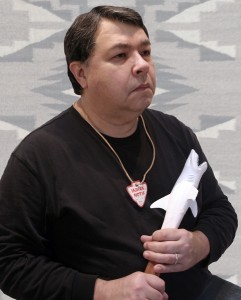
John Feodorov: Wednesday, November 1st, 2017 from 11:30-1pm in the Recital Hall, COM Building

Born in Los Angeles of mixed Native and European American heritage, John Feodorov grew up in the suburbs of Southern California while making annual visits to his family’s land on the Navajo Reservation. The time he spent with his grandparents on their homestead in New Mexico, near the Anasazi ruins at Chaco Canyon, continues to inform his work.

Feodorov’s art both engages and confronts the viewer through questioning assumptions about Spirituality, Identity and Place. Lately, he has been responding to ongoing environmental exploitation and degradation by both government and corporate sources, as well as their potential effects on how we relate to and understand our sense of Place.

John’s work has been featured in several publications; most recently in, Time and Time Again, by Lucy R. Lippard, and Manifestations, edited by Dr. Nancy Marie Mithlo.  He was also featured in the first season of the PBS series, “Art 21: Art for the 21st Century”.

He served as an Arts Commissioner for the City of Seattle and is presently an Associate Professor of Art at Fairhaven College at Western Washington University in Bellingham Washington. He currently writes and performs with his band, The Almost Faithful.

Storme Webber: Wednesday, 10/4 from 11:30-1pm in Recital Hall, COM Building

Storme Webber is a Two Spirit, Alutiiq/Black/Choctaw, internationally-nurtured poet, playwright, educator, and interdisciplinary artist. She creates blues-influenced, socially-engaged texts and images exploring identity, art activism, and the intersections of race, class, gender, sexuality, memory and spirit.

Storme’s poetry collections include DiasporaBlues Divine, and the forthcoming Noirish Lesbiana. Her solo theatre works include Buddy RabbitNoirish Lesbiana: A Night at the Sub Room, and Wild Tales of Renegade Halfbreed Bulldagger. She has been highlighted in numerous anthologies, documentaries (including Venus Boyz, May Ayim: Hope in HeartWhat’s Right with Gays These Days?Living Two Spirit), and international performance tours.

Storme is an inspired educator, bringing art, history & soul as a visiting artist in programs across the country. She enjoys teaching Creative Writing to young people at the University of Washington. She has served as featured faculty at Hedgebrook, Whidbey Island Writer’s Conference, Chuckanut Writer’s Conference, The University of Puget Sound, Seattle University, and Richard Hugo House.

Storme was honored to receive a 2015 James W. Ray Venture Project Award from the Artist Trust/Frye Art Museum Consortium. Storme’s work has also been supported & awarded by 4Culture, Hedgebrook, Richard Hugo House, Pride Foundation, Seattle Art Museum, CIRI Foundation, City of Seattle and Jack Straw Foundation.

Panel on Contemporary Native American Art featuring Wendy Red Star, John Feodorov, Sara Siestreem, and Corwin Clairmont: Wednesday, December 9th, 11:00-1:00 pm in the 2nd floor Recital Hall of the COM Building

Wendy Red Star

Wendy Red Star is an artist living and working in Portland, Oregon. Red Star received her B.F.A. from Montana State University-Bozeman and her M.F.A from UCLA in 2006. She has exhibited both nationally and internationally. Her exhibitions include shows at the Fondation Cartier pour l’Art Contemporain, Hallie Ford Museum, The Eiteljorg Contemporary Art Fellowship 2009, Utah Museum of Contemporary Art, Missoula Art Museum, St. Louis Art Museum, National Museum of the American Indian-New York, Portland Art Museum, Minneapolis Institute of Arts, Indianapolis Museum of Contemporary Art, Metropolitan Museum of Art, Bockley Gallery, and Haw Contemporary gallery. She has been a visiting lecturer at a range of respected institutions, including The Banff Centre, CalArts, National Gallery of Victoria (Melbourne), Portland State University, Dartmouth Hood Museum, Figge Art Museum, Fairhaven College, Fine Artworks Center-Provincetown, and I.D.E.A. Space-Colorado College.

JOHN FEODOROV

Born in Los Angeles of mixed Navajo (Diné) and Euro-American heritage, John Feodorov grew up in the suburbs of Southern California while making annual visits to his family’s land near Whitehorse, NM. The time he spent with his mother and grandparents on their homestead near the Anasazi ruins at Chaco Canyon continues to inform and impact his work.

John has been called a conceptual artist, a political artist, as well as a Native American artist, but he is still not sure how to define what he does. His work includes painting, drawing, assemblage, installation, video, music and songwriting. He also has engaged in experimental performance in the past, but not lately. Currently, he writes and performs with his art/pop band, The Almost Faithful.

John’s work as been widely exhibited and has been featured in several publications; most recently in Time and Time Again, by Lucy R. Lippard, and Manifestations, edited by Dr. Nancy Marie Mithlo.  He was also featured in the first season of the PBS  series, “Art 21: Art for the 21st Century”.

John has also worked with the Seattle-based afterschool arts program, Artscorps, and served as an Arts Commissioner for the City of Seattle. He is currently an Associate Professor of Art at Fairhaven College.

SARA SIESTREEM

Sara Siestreem (Hanis Coos and American, 1976-) is from the Umpqua River Valley in South Western Oregon. She grew up in Portland, Oregon. She is a Master Artist and Educator. She comes from a family of professional artists and educators and her training in both fields began in the home. Siestreem graduated Phi Kappa Phi with a BS from PSU in 2005. She earned an MFA with distinction from Pratt Art Institute in 2007. Siestreem is the weaving student of Greg Archuleta, Greg Robinson, and Nan MacDonald. She is represented by Augen Gallery in Portland and her work has been shown in museums and figures in prestigious private and public collections nationally.

Her studio work is multi-disciplinary. Her primary language is painting, but she also works in photography, printmaking, drawing, sculpture, video, and traditional weaving.

She teaches Foundations in Studio Arts and Indigenous Studies at PSU and Traditional Weaving Practices for The Confederated Tribes of Coos, Lower Umpqua, and Siuslaw Indians. She works as a consultant and free lance educator for museums and cultural groups regionally. Siestreem also serves various youth organizations and individuals in the role of mentor, workshop leader, promoter, public speaker and volunteer.

She lives and works exclusively in the arts in Portland, Oregon.

CORWIN CLAIRMONT

Corwin (Corky) Clairmont is a contemporary artist and enrolled member of the Confederated Salish and Kootenai Tribes.   Living in Los Angeles, Corky  pursued a contemporary exhibiting artist career as well as teaching and becoming department head of  printmaking at the Otis/Parsons Art Institute located in Los Angeles, Ca. Upon his return to Montana in 1984, Corky began administrative work at the newly credited Salish Kootenai College located in Pablo, Montana on the Confederated Salish and Kootenai Reservation.  This included the creation of the SKC  Fine Arts Department and art degree program. Through work as a printmaker, conceptual and installation artist, Corky’s images   discuss and explore situations or issues that effect tribal people such as sovereignty, colonization, giving a cultural and historical perspective.   Corky’s artwork has been exhibited through out the United States and in several Countries including Germany Norway, New Zealand, France, and most recently at the US Embassy located in Kinshasa, Democratic Republic of Congo, Africa.  Awards have included Ford and National Endowment of the Arts, the Eiteljorg Fellowship Award, and the 2008 Montana Governors Award for Visual Arts.  He currently serves on the State Board of the Montana Arts Council.

© 2026 Art Lecture Series

Theme by Anders NorenUp ↑