The Evergreen State College

Tag: landscapes

Week 6: Susanna Bluhm Wednesday, October 31st 2018,11:30-1pm in Lecture Hall 1

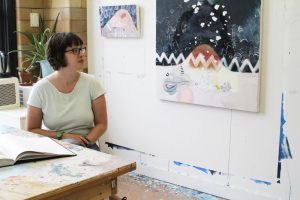
From Susanna

My paintings are usually related in some way to my physical environments and experience of them. Source material I draw from when I’m painting often includes photographs I’ve taken of places I’ve been. Also, the paintings are experiments in creating new environments. An individual painting can become a new place in itself, with sensations of things that might happen in a place, such as weather, touch, landscape, temperature, sex or noise. Abstract marks interact with more recognizable shapes, and a kind of narrative ensues.

When talking or writing about my work, I stray from defining the narratives in a literal way. Instead, I try to describe them as I see them, both as the person that made them and decided they make sense, and also as a witness to the end result.

Semi-abstract “characters” show up in the paintings and suggest meanings with their repetition and associations with each other. For example, a chunk of green and white stripes has its origins in the green and white striped pajama bottoms from Suzanne Valadon’s The Blue Room, 1923. To me, this “character” feels like a queer, feminist reclaiming of the history of painting. A pink fir tree is an odd, out-of-place Pacific Northwestern interloper and solo eloper in the big city.

Making these semi-abstract landscape-based paintings with a personal narrative running underneath is a three-pronged effort. I am looking at my agency in the landscape. I am trying to spend more time in the place by painting it. I’m using paint to make physical contact again. In this intimate way, the paintings explore landscape as a lover and loved one, enmeshed with the paint, and without the safe distance usually afforded by the Sublime in traditional Western landscape painting.

I think of both painting and looking as pleasureful experiences.

Susanna Bluhm 2018

BIO:

Susanna Bluhm is an artist based in Seattle, WA. After growing up in a suburb of Los Angeles, she earned her BA in Studio Art from California State University Humboldt and her MFA in Painting from the University of Illinois at Urbana-Champaign. She has been an Artist-in-Residence at the Irish Museum of Modern Art in Dublin and at the Karl Hofer Gesellschaft in Berlin. Bluhm was a member of SOIL artist-run gallery (Seattle) for five years, and was the 2014 recipient of the Neddy Artist Award in Painting. She lives with her wife and ten-year-old son in Seattle.
Week 4: Rodrigo Valenzuela Wendesday, October 17th 2018, 11:30-1pm in Lecture Hall 1

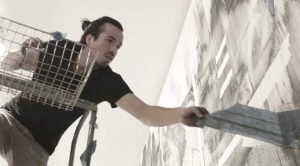
from Rodrigo

I construct narratives, scenes, and stories which point to the tensions found between the individual and communities. I utilize autobiographical threads to inform larger universal fields of experience. Gestures of alienation and displacement are both the aesthetic and subject of much of my work. Often using landscapes and tableaus with day laborers or myself, I explore the way an image is inhabited, and the way that spaces, objects and people are translated into images. My work serves as an expressive and intimate point of contact between the broader realms of subjectivity and political contingency. Through my videos and photographs, I make images that feel at the same time familiar yet distant. I engage the viewer in questions concerning the ways in which the formation and experience of each work is situated—how they exist in and out of place.

Jovencio de la Paz: Wednesday, April 20th, 11:30-1:00 pm in the 2nd floor Recital Hall of the COM Building

Jovencio de la Paz is an artist, writer, and educator working at the intersection of contemporary art, craft, and textile. His work, which is committed to the ancient technologies and processes of textile, engages notions of identity, immigration, and the terrain of thought around human interaction with the landscape. Working with a range of materials, including indigo dye, traditional batik, textile printing, and multimedia strategies, Jovencio seeks to work in an expansive way, engaging highly specific materials and processes as sites to confront larger concerns of human migration and the narratives associated with such movement.
Jovencio was born in Singapore, and became a citizen of the United States in 1994. He received a BFA from the School of the Art Institute of Chicago in 2008, and an MFA from the Cranbrook Academy of Art, Department of Fiber, in 2012. Recent solo and group exhibitions include shows at ThreeWalls, Chicago, IL; The Museum of Contemporary Craft, Portland, OR; 4th Ward Projects, Chicago, IL; PDX Contemporary Art, Portland, OR; The Sculpture Center, Cleveland, OH; SOIL Gallery, Seattle, WA; Roots & Culture Contemporary Art Center, Chicago; The Hyde Park Art Center, Chicago; MessHall, Chicago; Uri Gallery, Seoul, South Korea, among others. He regularly teaches at schools of art, craft, and design throughout the country, including the Ox Bow School of Art in Saugatuck, MI and the Arrowmont School of Craft in Tennessee. Jovencio de la Paz is Assistant Professor and Curricular Head of Fibers at the University of Oregon. He is also a co-founder of the collaborative group Craft Mystery Cult, established in 2010.
https://youtu.be/BquzYI4Fi1E

Honoring Evergreen’s Steve Davis: Wednesday, February 10th, 11:30-1:00 pm in the 2nd floor Recital Hall in the COM Building

Steve Davis is a documentary portrait and landscape photographer based in the Pacific Northwest.  His work has appeared in American PhotoHarper’s, the New York Times Magazine, Russian Esquire, and is in many collections, including the Houston Museum of Fine Arts, the Seattle Art Museum, the Santa Barbara Museum of Art, and the George Eastman House. He is a former 1st place recipient of the Santa Fe CENTER Project Competition, and two time winner of Washington Arts Commission/Artist Trust Fellowships.  Davis is the Coordinator of Photography, media curator and adjunct faculty member of The Evergreen State College. He is represented by the James Harris Gallery, Seattle.

Allison Cobb: Wednesday, February 11th, 2015, 11:30-1:00 pm in Lecture Hall 1

Allison Cobb is the author of Born2 (Chax Press) about her hometown of Los Alamos, New Mexico, and Green-Wood (Factory School) about a nineteenth-century cemetery in Brooklyn, New York. The New York Times called Green-Wood “a gorgeous, subtle, idiosyncratic gem.”

Cobb’s work combines history, nonfiction narrative and poetry to address issues of landscape, politics, and ecology. She is a 2015 Djerassi Resident Artist; a 2014 Playa Resident Artist; she received a 2011 Individual Artist Fellowship award from the Oregon Arts Commission; and she was a 2009 New York Foundation for the Arts Fellow. She works for the Environmental Defense Fund. She lives in Portland, Oregon.

Dan Attoe: Wednesday, October 22nd, 2014, 11:30-1:00 pm in Lecture Hall 1

Dan Attoe was born in 1975 in Bremerton, Washington.  He grew up in parts of Washingon, Idaho, Minnesota and Wisconsin, and now lives in Washougal, Washington.  He received his BFA from the University of Wisconsin in ’98 and his MFA from the University of Iowa in ’04. Dan is represented by Peres Projects Berlin, Western Exhibitions in Chicago and Fourteen30 Contemporary in Portland, Oregon.  He has had several solo shows in Los Angeles, Chicago and Berlin, as well as several throughout Europe.

His most recent gallery solo shows were Landscapes with Water, at Peres Projects in Berlin in March 2014, and Dan Attoe at 1430 Contemporary in Portland in May 2014.  Dan has been in numerous group shows in galleries all over the world and several museums – including the Portland Art Museum.  He worked with and was part of the inspiration for a line of clothing by fashion designer Adam Kimmel in 2011.  Dan is also one of the founders of the art collaborative Paintallica whose most recent installation was at the Iowa State Fair in Des Moines. He enjoys the beauty and the culture in the Northwest and Portland where he sometimes teaches courses at Portland State University.

Stephen Hayes: Wednesday, February 12, 2014 11:30-1:00 pm in Lecture Hall 1

Stephen Hayes was born and raised in Washington D.C. where his earliest memory of an interest in art is of a drawing he made with silver crayons of John Glenn and his “Rocket Ship” in 1960 something. He was about six.

The mature artist, Stephen Hayes, received his MFA from the University of Wisconsin in Madison in 1980, having focused on drawing and specifically on drawing the human form. His studies took him as far as a full dissection of the cadaver via the University Medical School, culminating in a thesis on portraiture.

Immediately following graduate school, Hayes moved to the Middle East for nearly four years where he was overwhelmed by the awesome beauty of the Cypriot landscape. It was there that his interest in the land as a vehicle for expression of human condition began. His travels and work in Lebanon, Syria, Jordan, Bahrain and Cyprus planted a seed that is still bearing fruit in his work today. While his landscape paintings are rarely populated, there is always the sense that we have knowledge of the place, or the mood, or the potency of place. This quality is a result of years spent walking alone through natural and often rugged beauty, and drinking that quality in to the core.

In 1984 Hayes moved first back to Washington for a brief stint at the Phillips Collection as one of their Museum Assistants, and then within six months decided to go somewhere unknown. He headed west and settled in Portland, Oregon where he currently lives. He continues through his painting and print work, to translate, viscerally, the physical and emotional experience of places of nature.

In the roughly 25 years that Hayes has spent working and teaching in Portland he has participated in scores of exhibitions and produced dozens of one-man shows of his paintings, prints and drawings. Hayes has received awards that include a WESTAF Individual Artist Fellowship, an Oregon Arts Commission Individual Artist Fellowship, and is a 2011 recipient of the Hallie Ford Fellowship for Individual Artists.

He is represented in Portland by the Elizabeth Leach Gallery and his work can be found in numerous private, public and corporate collections throughout the United States, as well as in Europe, Japan and South America.

Pam Minty and Alain LeTourneau screen their film “Empty Quarter,” Wednesday May 30, 2012, 11:30-1:30, LH1

Pam Minty and Alain LeTourneau present their 2011 film Empty Quarter on Wednesday May 30, 2012, 11:30-1:30, in Lecture Hall 1 at The Evergreen State College.

film website | read reviews | view clips

Empty Quarter (2011, 16mm black & white/sound, 71 minutes) is a film about the region of Southeast Oregon, an area populated by ranching and farming communities, in Lake, Harney, and Malheur counties. The region is roughly one-third of Oregon’s landmass yet holds less than 2% of the state’s population.

Southeast Oregon, though familiar by name, is a foreign place, particularly to those who reside in urban environments. It is a landscape in the making, constantly undergoing change, being re-worked. It is a highly politicized landscape, evoking differing opinions concerning resource management and land use. It is also a landscape that is, despite some beliefs, rich with diversity, as seen by the presence of East Indian and Japanese families, ancestors of Basque sheepherders, home to the Paiute tribes people, and to Latinos who have come to help work the land.

Empty Quarter departs from a documentary form that utilizes “talking head” interviews and “B-roll” or “cut-away” images tied together with occasional narration. The film instead presents stark portraits, waiting to be explored and digested by the viewer. Meaning is extracted in the slow process of accumulation and measured response. Through a series of stationary shots, recording open landscapes and the activities of local residents, Empty Quarter reflects on the character of the region. Natural areas are viewed among images of industry, various labor processes, resource management and recreation. Voices of local residents describe the history of pioneer settlement, social life of rural communities and the struggles of small town economies.

Pam Minty and Alain LeTourneau are media artists based in Portland, Oregon. They are the co-founders of 40frames.org, a 16mm film preservation and advocacy organization that maintains the web resource 16mmdirectory.org, houses a collection of 16mm prints, and provides a menu of technical services to media artists and organizations.

Empty Quarter is their first co-production, and has been exhibited at venues and festivals throughout North America, including the Film Studies Center at the University of Chicago, Margaret Mead Film Festival, and the Vancouver International Film Centre. Minty and LeTourneau are currently at work on new projects scheduled for release winter 2013.

Deborah Stratman: Wednesday, February 9, 2011 12:15-1:30, Lecture Hall 1.

Deborah Stratman is a Chicago-based artist and filmmaker interested in landscapes and systems. Her films, rather than telling stories, pose a series of problems – and through their at times ambiguous nature, allow for a complicated reading of the questions being asked. She has exhibited internationally at venues including the Whitney Biennial, MoMA, the Pompidou, Hammer Museum and many international film festivals including Sundance, the Viennale, Ann Arbor and Rotterdam. She is the recipient of Fulbright and Guggenheim fellowships and she currently teaches at the University of Illinois at Chicago.

Free to the public.

A free screening of “O’er the Land” will be held on Tuesday, February 8th at 8pm at the Northern in downtown Olympia. 

http://www.northernolympia.org/2011/01

© 2026 Art Lecture Series

Theme by Anders NorenUp ↑