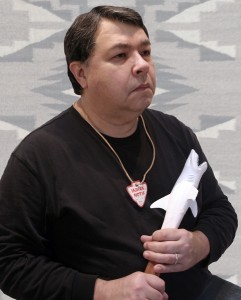
Born in Los Angeles of mixed Native and European American heritage, John Feodorov grew up in the suburbs of Southern California while making annual visits to his family’s land on the Navajo Reservation. The time he spent with his grandparents on their homestead in New Mexico, near the Anasazi ruins at Chaco Canyon, continues to inform his work.
Feodorov’s art both engages and confronts the viewer through questioning assumptions about Spirituality, Identity and Place. Lately, he has been responding to ongoing environmental exploitation and degradation by both government and corporate sources, as well as their potential effects on how we relate to and understand our sense of Place.
John’s work has been featured in several publications; most recently in, Time and Time Again, by Lucy R. Lippard, and Manifestations, edited by Dr. Nancy Marie Mithlo. He was also featured in the first season of the PBS series, “Art 21: Art for the 21st Century”.
He served as an Arts Commissioner for the City of Seattle and is presently an Associate Professor of Art at Fairhaven College at Western Washington University in Bellingham Washington. He currently writes and performs with his band, The Almost Faithful.
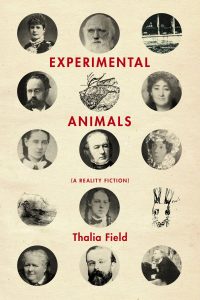
Thalia Field’s most recent book, Experimental Animals (A Reality Fiction), explores the history of animals at the foundation of modern science. Her prior collection, Bird Lovers, Backyard, used animal-human relations to engage questions of hybridity in art and science. Prior collections include Point and Line, Incarnate: Story Material, as well as a performance novel, ULULU (Clown Shrapnel), and two essay-fiction collaborations with French writer, Abigail Lang: A Prank of Georges, and the forthcoming Legends of Janus/Leave to Remain.
Thalia teaches in the Literary Arts program at Brown University.
Storme Webber is a Two Spirit, Alutiiq/Black/Choctaw, internationally-nurtured poet, playwright, educator, and interdisciplinary artist. She creates blues-influenced, socially-engaged texts and images exploring identity, art activism, and the intersections of race, class, gender, sexuality, memory and spirit.
Storme’s poetry collections include Diaspora, Blues Divine, and the forthcoming Noirish Lesbiana. Her solo theatre works include Buddy Rabbit, Noirish Lesbiana: A Night at the Sub Room, and Wild Tales of Renegade Halfbreed Bulldagger. She has been highlighted in numerous anthologies, documentaries (including Venus Boyz, May Ayim: Hope in Heart, What’s Right with Gays These Days?, Living Two Spirit), and international performance tours.
Storme is an inspired educator, bringing art, history & soul as a visiting artist in programs across the country. She enjoys teaching Creative Writing to young people at the University of Washington. She has served as featured faculty at Hedgebrook, Whidbey Island Writer’s Conference, Chuckanut Writer’s Conference, The University of Puget Sound, Seattle University, and Richard Hugo House.
Storme was honored to receive a 2015 James W. Ray Venture Project Award from the Artist Trust/Frye Art Museum Consortium. Storme’s work has also been supported & awarded by 4Culture, Hedgebrook, Richard Hugo House, Pride Foundation, Seattle Art Museum, CIRI Foundation, City of Seattle and Jack Straw Foundation.
Meehan Crist is writer-in-residence in Biological Sciences at Columbia University. Previously she was editor-at-large at Nautilus and reviews editor at the Believer. Her work has appeared in publications such as the New York Times, the Los Angeles Times, Lapham’s Quarterly, Tin House, New Republic, Nautilus, the Believer, Bookforum, Scientific American, and Science. Awards include the 2015 Rona Jaffe Foundation Writer’s Award, the 2016 AOA Award for excellence in Health Journalism, the Olive B. O’Connor Fellowship and fellowships from MacDowell, The Blue Mountain Center, Ucross, and Yaddo.
Dawn Cerny is a multidisciplinary artist based in Seattle. Her recent works on paper and in sculpture examine the formal articulation of value and power—or lack thereof—through everyday gestures, bodily postures, and personal aesthetic choices. Cerny’s monochromatic sculptural works also evoke racks, chairs, and cabinets of uncertain purpose, at once amplifying and distorting furniture’s connection to the human form. Amassed together within the gallery, they might comprise a domestic arrangement, a showroom, or a crowd of people, alone together in public space. Like Buster Keaton’s slapstick comedy—a favorite of the artist’s—Cerny’s sculptures can be seen as an absurdist response to the productive rationalism of modern times, one that both represents and is alienated from everyday life. Cerny’s work has been exhibited at many venues including Henry Art Gallery; Or Gallery in Vancouver, Canada; Night Gallery in LA and Derk Eller Gallery in New York.
Gregg Horowitz is Professor of Philosophy at Pratt. He writes on aesthetics, the philosophy of art, theories of art history, psychoanalysis, and political theory. His publications include the books Sustaining Loss: Art and Mournful Life (Stanford, 2001) and The Wake of Art: Philosophy, Criticism and the Ends of Taste (Routledge, 1998, with Arthur C. Danto and Tom Huhn) and articles on “Robert Pippin’s After the Beautiful: Hegel and the Philosophy of Pictorial Modernism” (Platypus Review, 2014).“Tradition” (Art Bulletin, 2013), “A Made-to-Order Witness: Women’s Knowledge in Vertigo” in Katalin Makkai, ed., Vertigo: Philosophers on Film (Routledge, January 2013), and “The Homeopathic Image, or, Trauma, Intimacy and Poetry,” (Critical Horizons, 2010). He is also a past Fellow of the American Academy in Berlin.
Margot Quan Knight‘s photography and video work has been featured in over 70 international publications and exhibited around the world, including solo shows at GAS Art Gallery, (Turin, Italy), 911 Media Arts Center, (Seattle, W.A.), and California State University (Chico, CA) and group shows at the Centre Pompidou (Paris, France), Ar/ge Kunst Galleria Museo (Bolzano, Italy), and the Dotmov Festival (Sapporo, Japan). Margot received a Master in Fine Art degree from the Milton Avery Graduate School of the Arts at Bard College in 2009.
Alexis Pauline Gumbs, multi-disciplinary artist, scholar, activist and this year’s Evan’s Chair at The Evergreen State College. As an educator, Alexis Pauline Gumbs walks in the legacy of black lady school teachers in post-slavery communities who offered sacred educational space to the intergenerational newly free in exchange for the random necessities of life. She honors the lives and creative works of Black feminist geniuses as sacred texts for all people. She believes that in the time we live in access to the intersectional, holistic brilliance of the black feminist tradition is as crucial as learning how to read. She brings that approach to her work as the provost of the Eternal Summer of the Black Feminist Mind, a transmedia- enabled community school (aka tiny black feminist university) and lending library based in Durham, North Carolina.
A queer black troublemaker, a black feminist love evangelist and a prayer poet priestess, Alexis has a PhD in English, African and African-American Studies, and Women and Gender Studies from Duke University. She was the first scholar to research the Audre Lorde Papers at Spelman College, the June Jordan Papers at Harvard University, and the Lucille Clifton Papers at Emory University during her dissertation research.
Dawn Lundy Martin is a poet, essayist, and conceptual video artist. She is the author of three books of poems and three chapbooks, including most recently, Life in a Box is a Pretty Life (Nightboat Books 2015) and Good Stock Strange Blood (forthcoming from Coffee House Press in 2017). She is currently at work on a memoir. Her nonfiction has appeared in The New Yorker, Harper’s, and other magazines.
Martin is also a co-founder of the Black Took Collective, an experimental performance art/poetry group of three, and a member of HOWDOYOUSAYYAMINAFRICAN?, a global arts collective. She has been awarded the 2015 Lambda Literary Award for Lesbian Poetry and a 2016 Investing in Professional Artists Grant from the Pittsburgh Foundation and the Heinz Endowments. Martin is Professor of English at the University of Pittsburgh and Co-director of the Center for African American Poetry and Poetics.
Identifying himself as a “gay folk artist,” Jeffry Mitchell creates work that deals largely with dualities. Using a variety of materials and methods, including ceramics, printmaking, and drawing, Mitchell manages to juxtapose seemingly disparate ideas into beautiful, fragile, and startling works. Using sweet, furry animals and soft, pastel colors, Mitchell transforms kitsch subject matter into a study of complex human experiences, including death, sex, religion, and loss. His work, at times appearing clumsy and hand-wrought, remains approachable and innocent, engaging viewers with his child-like curiosity and ungainly re-creations of recognized subjects. While highly sophisticated in his technique, Mitchell chooses to display vulnerability in his work, allowing both himself and his viewers to negotiate frightening realities by couching them in the comfort of the familiar and a faith in innocence. His work is suffused with a desire to welcome, accept, and even love the disconcerting and flawed aspects of ourselves and others.
Jeffry Mitchell was born in 1958, the fourth of nine children of working-class parents. After experiencing a largely itinerant childhood owing to his father’s career, Mitchell continued this nomadic lifestyle in his young adulthood. Although his family eventually established a somewhat permanent residency in Seattle, he decided to attend the University of Dallas in Irving, Texas, and spent a semester in Rome, an experience that had a profound effect on his work. After graduating with a BA in painting, Mitchell moved to Japan to teach English and landed an apprenticeship with a production potter in Seto (known as one of the “Six Old Kilns” in traditional Japanese pottery). Impressed and changed by his experiences abroad, Mitchell returned to Seattle in 1984 and enrolled in a printmaking class at the Cornish College of the Arts. This spurred his decision to pursue an MFA in printmaking at the Tyler School of Art, Temple University in Philadelphia. During his studies he returned to Rome, setting up a studio in the basement classrooms at Villa Caproni. Notable solo exhibitions of Mitchell’s work include: Like a Valentine: The Art of Jeffry Mitchell, 2012-2013, Henry Art Gallery; Some Things and Their Shadows, 2009, Kittredge Gallery, University of Puget Sound, Tacoma, WA; Shiny Happy Pretty (with Tina Hoggatt), 2008, Missoula Art Museum; Hanabuki, 2001, Henry Art Gallery; My Spirit, 1992, New Museum of Contemporary Art, NY; and Documents Northwest: The Poncho Series, 1990, Seattle Art Museum. (from the Henry Art Gallery website)