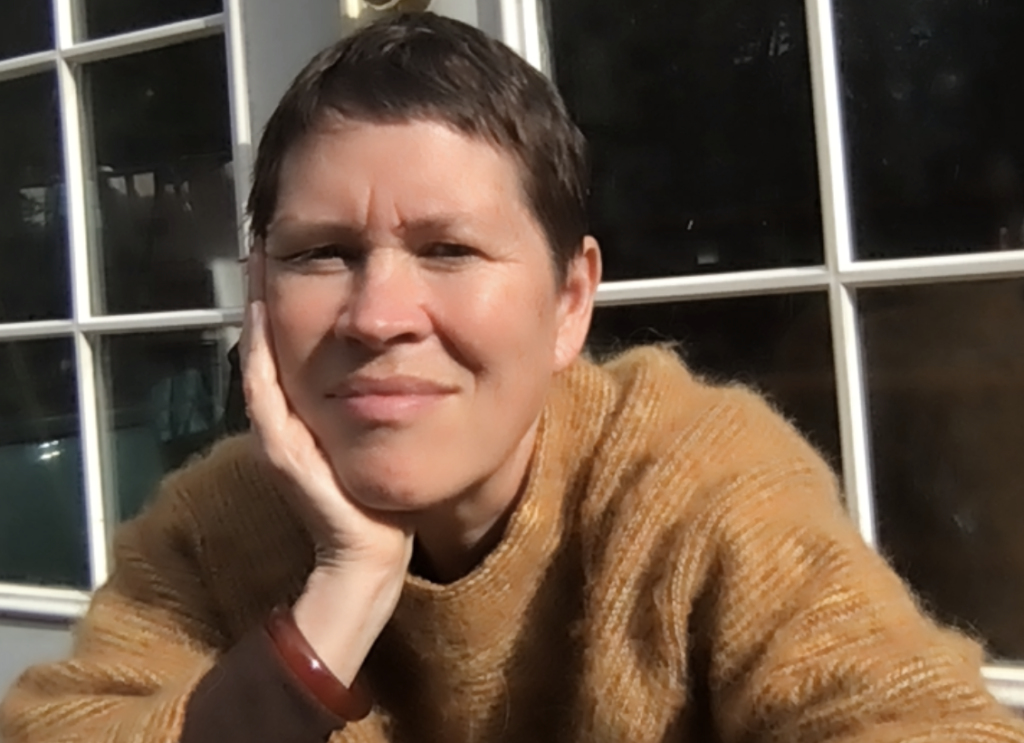
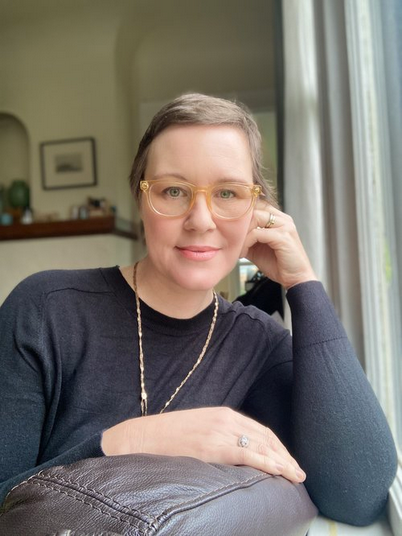
Shaw Osha is an artist and educator and has just finished an assemblage that reimagines her work over the last ten years as an artist’s book. The book mixes painting projects with writing to contemplate the relentlessness of racialization in American culture since slavery. Using fragile and unstable materials like pigments, flowers, paper, emotions, and language, her book compares, intersects, and maybe fleetingly locates a haunting of a personal, collective, and social ghost that resists comprehension or meaning but returns and repeats.
She has exhibited work in venues including New York’s Pocket Utopia; The Hedreen Gallery at Seattle University; Satellite UNC in Chapel Hill, NC, and the Ali Center in Louisville, KY. She is a member of the faculty at Evergreen and teaches an interdisciplinary arts curriculum that allows students to study at the intersections of intellectual, research, and creative activity.
Cerny’s sculptures begin with the notion that “furniture” and “mother” are figures that secure a value (to others) for their potential to hold, display, or be absent-mindedly left with things. Putting form and color to work and entrusting no small part to contingency, these works behave as something like gestural understudies for a play about the day-to-day grinding weariness and joyful slapstick absurdity of human relationship—about trying to Work It Out…or not.
Catharina Manchanda is the Jon and Mary Shirley Curator of Modern and Contemporary Art at the Seattle Art Museum.
Originally from Germany, Catharina Manchanda received her Ph.D. in art history from the City University of New York (2005), where she wrote her dissertation on conceptual art and photography in 1960-70s German art.
Recent and current exhibitions include: Joyce J. Scott: Walk a Mile in My Dreams, the artist’s 50-year career retrospective, co-curated with Cecilia Wichmann at the Baltimore Museum of Art (October 17 2024-January 19, 2025); Elizabeth Malaska: All Be Your Mirror (November 17, 2023-June 16, 2024). Upcoming: Bethany Collins: At Sea (November 14, 2024-May 4, 2025); Following Space: Thaddeus Mosley & Alexander Calder (November 20, 2024-June 1, 2025).
Christopher Paul Jordan is a painter and public artist from Tacoma, Washington. Lacing salvaged textiles such as window screens and debris netting with acrylic paint, Jordan simulates cycles of removal to surface questions about human relationships. Through parallel practices in performance, installation, and sculpture, his investigations are often staged or permanently embedded in public space. Jordan’s first museum exhibition: In The Interim – Ritual Ground for a Future Black Archive, buries African American predictions of the end of the world on the grounds of the Frye Art Museum until the year 2123. His 20ft bronze, aluminum, and steel sculpture andimgonnamisseverybody (2021) is the centerpiece for The AIDS Memorial Pathway in Seattle. Jordan holds an MFA in Painting and Printmaking from the Yale School of Art (2023).
Rachelle Mozman is an artist whose work is primarily based in photography and video. Through close study of the history of the Americas and the practice of psychoanalysis, her work seeks to situate the self in historical time, while contemplating possible futures. Born in New York City, Mozman now works between Brooklyn and Panama, “the home of [her] family, and deepest love stories.” Her work makes visual the often hidden mythologies reified by structures of power – “including the internalized kind.” Mozman is a Fulbright Fellow, and has exhibited in galleries in the United States, Mexico, Germany, France, Chile, Uruguay, and more. In 2021 she had a solo exhibition, All These Things I Carry with Me, at South Bend Museum, South Bend, IN. In 2020 Mozman released her monograph, Colonial Echo with Kris Graves Projects.
Satpreet Kahlon is a Panjabi-born artist, organizer, and educator based on Coast Salish territories. She received a full-fellowship to pursue her MFA in Sculpture from the Rhode Island School of Design, graduating in 2019. She co-founded and -ran an Indigenous arts organization that supported 400 artists with over $2m of opportunities and rematriated 1.5 acres of greenspace that was slated for development during her tenure from 2017-2023. For this work, she was named one of the Most Influential People in Seattle by Seattle Magazine in 2019.
Regarding her artistic practice, she has written in a statement: “My practice is concerned with illegibility, inscrutability, and collapse. Beginning with the understanding that most Indigenous cultures are existing in a post-apocalyptic reality, I approach the act of building sculpture as a kind of prayer: a futile attempt to communicate with and better know generations of lost, unknowable histories. An endlessly looping signal without reply.”
Ellen Levy is the author of A Book About Ray (MIT Press, 2024), the first full-length survey of the career of the collagist and correspondence artist Ray Johnson (American, 1927-1995). Her other writings include Criminal Ingenuity: Moore, Cornell, Ashbery, and the Struggle Between the Arts (Oxford UP, 2011), and essays and reviews on poetry, visual art, theater, and television in such publications as Dissent, Genre, Modernism/Modernity, The Nation, Parkett, and Twentieth-Century Literature. She has taught at Pratt Institute, the School of Visual Arts, and Vanderbilt University.
Jessica Jackson Hutchins (b. 1971) lives and works in Portland, Oregon. Hutchins’ expressive and intuitive studio practice produces dynamic sculptural installations, collages, paintings, and large-scale ceramics, all hybrid juxtapositions of the handmade. As evidence of the artist’s dialogue with items in her studio, these works are a means by which the artist explores the intimacy of the mutual existence between art and life. Her transformations of everyday household objects, from furniture to clothing, are infused with human emotion and rawness, and also show a playfulness of material and language that is both subtle and ambitious. Based upon a willingly unmediated discourse between artist, artwork and viewer, Hutchins’ works ultimately serve to refigure an intimate engagement with materiality and form.
Rafael Soldi is a Peruvian-born artist and independent curator based in Seattle (unceded Indigenous land of the Coast Salish peoples). His practice centers on how queerness and masculinity intersect with larger topics of our time such as immigration, memory, and loss. Rafael has exhibited internationally at the Frye Art Museum, Frost Art Museum, Griffin Museum of Photography, CLAMP, The Print Center, Museo MATE, Filter Space, and Burrard Arts Foundation, among others. He has received support from the The Andy Warhol Foundation for Visual Arts, The Northwest Film Forum, Puffin Foundation, smART Ventures, Artist Trust, 4Culture, the Seattle Office of Arts & Culture, and Center Santa Fe. He has been awarded fellowships at MacDowell, Bogliasco Foundation, Vermont Studio Center, and PICTURE BERLIN. He was a 2022 finalist for the Seattle Art Museum’s Betty Bowen Award.
His work is in the permanent collections of the Museum of Finer Arts, Houston, Tacoma Art Museum, Frye Art Museum, King County Public Art Collection, and the Pennsylvania Academy of Fine Arts. Rafael’s work has been reviewed on ARTFORUM, The Seattle Times, The Boston Globe, Photograph Magazine, The Seen, Art Nexus, and PDN. He is the co-founder of the Strange Fire Collective, a project dedicated to highlighting work made by women, people of color, and queer and trans artists; and co-curator of the High Wall, a yearly outdoor video projection program that invites immigrant artists and artists working on themes of diaspora and borderlands to intervene the facade of a former immigration center building in the heart of Seattle.
Rafael holds a BFA in Photography & Curatorial Studies from the Maryland Institute College of Art.
Pamela Lins refers to her work primarily as sculpture, although she uses the term expansively. She teaches sculpture at the Cooper Union for the Advancement of Science and Art and painting at Princeton University. Through her work, Lins contemplates the social, the political, and the historical by constructing situations inquisitive and equivocal to sculpture and the making of it. Lins’ work explores the space and connections between painting and sculpture, sometimes with a focus on ceramics, leading her to found Ceramics Club with Trisha Baga. Previously, Lins’ work was included in the 2014 Whitney Biennial, in a collaboration with Amy Sillman, and has been exhibited at the Tang Museum of Art, The Suburban, the CCS Bard Hessel Museum of Art, and the Brooklyn Museum of Art. She is represented by Rachel Uffner Gallery in New York. A New York Times review of her 2015 show ‘model, model, model’ describes her exploration of the links between painting and photography. In 2008 Lins received a fellowship from the John Simon Guggenheim Memorial Foundation, and in 2007 she was awarded a fellowship in the visual arts from the George A. and Eliza Gardner Howard Foundation. In 2013-14, she held the David and Roberta Logie Fellowship at the Radcliffe Institute for Advanced Study at Harvard University.