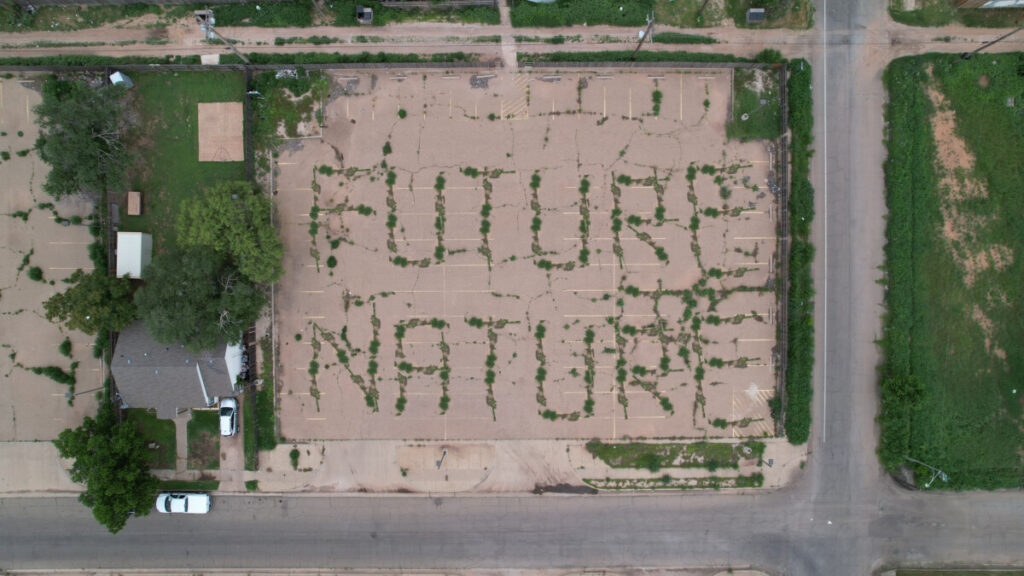
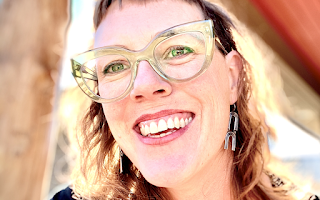
Erin Charpentier and Travis Neel work at the unruly edges of art and urban ecology to explore the possibility of collaborative survival within the weedy entanglements of human-disturbed landscapes. Their collaborative work has been supported and recognized by the National Endowment for the Arts, the Mid-America Arts Alliance’s Interchange Artists Fellowship program, Headlands Center for the Arts, Southwest Contemporary, the British Cultural Council, Stoveworks Artist Residency, the Tallgrass Artist Residency, the Brooklyn Art Museum, the Tacoma Art Museum, the Portland Art Museum, the Atlantic Center for the Arts, Temple Contemporary, the Portland Institute for Contemporary Art, the RedLine Contemporary Art Center, and numerous DIY art spaces across the United States and Canada.
Jessica Jackson Hutchins (b. 1971) lives and works in Portland, Oregon. Hutchins’ expressive and intuitive studio practice produces dynamic sculptural installations, collages, paintings, and large-scale ceramics, all hybrid juxtapositions of the handmade. As evidence of the artist’s dialogue with items in her studio, these works are a means by which the artist explores the intimacy of the mutual existence between art and life. Her transformations of everyday household objects, from furniture to clothing, are infused with human emotion and rawness, and also show a playfulness of material and language that is both subtle and ambitious. Based upon a willingly unmediated discourse between artist, artwork and viewer, Hutchins’ works ultimately serve to refigure an intimate engagement with materiality and form.
Artist and researcher Nina Elder creates deep time perspectives where planets, geology, and ecosystems are in constellation with social issues and personal narratives. With a focus on changing cultures and ecologies, Nina advocates for collaboration, fostering relationships between institutions, artists, scientists and diverse communities. Her work takes many forms, including drawings, murals, performance, pedagogy, and long term community-based projects.
Recent solo exhibitions of Nina’s work have been organized by SITE Santa Fe, Indianapolis Contemporary, Utah Museum of Contemporary Art, and university museums across the US. Her work has been featured in Art in America, VICE Magazine, Hyperallergic, and on PBS. Her writing has been published in American Scientist and Edge Effects Journal and other scientific publications. Nina’s research has been supported by the Andy Warhol Foundation, the Rauschenberg Foundation, the Pollock Krasner Foundation, and the Mellon Foundation. Nina migrates between projects, adventures, and her rural home in New Mexico.
Rafael Soldi is a Peruvian-born artist and independent curator based in Seattle (unceded Indigenous land of the Coast Salish peoples). His practice centers on how queerness and masculinity intersect with larger topics of our time such as immigration, memory, and loss. Rafael has exhibited internationally at the Frye Art Museum, Frost Art Museum, Griffin Museum of Photography, CLAMP, The Print Center, Museo MATE, Filter Space, and Burrard Arts Foundation, among others. He has received support from the The Andy Warhol Foundation for Visual Arts, The Northwest Film Forum, Puffin Foundation, smART Ventures, Artist Trust, 4Culture, the Seattle Office of Arts & Culture, and Center Santa Fe. He has been awarded fellowships at MacDowell, Bogliasco Foundation, Vermont Studio Center, and PICTURE BERLIN. He was a 2022 finalist for the Seattle Art Museum’s Betty Bowen Award.
His work is in the permanent collections of the Museum of Finer Arts, Houston, Tacoma Art Museum, Frye Art Museum, King County Public Art Collection, and the Pennsylvania Academy of Fine Arts. Rafael’s work has been reviewed on ARTFORUM, The Seattle Times, The Boston Globe, Photograph Magazine, The Seen, Art Nexus, and PDN. He is the co-founder of the Strange Fire Collective, a project dedicated to highlighting work made by women, people of color, and queer and trans artists; and co-curator of the High Wall, a yearly outdoor video projection program that invites immigrant artists and artists working on themes of diaspora and borderlands to intervene the facade of a former immigration center building in the heart of Seattle.
Rafael holds a BFA in Photography & Curatorial Studies from the Maryland Institute College of Art.
Stefan Bird-Pollan is a Professor of Philosophy at the University of Kentucky. He is interested in ethical theories; his first book, Hegel, Freud and Fanon; the Dialectic of Emancipation shows how Fanon’s view of the subject preserves insights of enlightenment while steering clear of racial prejudices which are endemic in European and American society. He is currently working on a book in which he develops an account of Kant’s ethical theory. His second project concerns the metapsychological type of voters who are attracted to different kinds of authoritarian rule. In addition, Stefan is working on several articles on Hegel, both his aesthetics and the Phenomenology of Spirit. He has published articles in numerous journals, including Radical Philosophy, Critical Horizons, Philosophy and Social Criticism and Public Reason. Stefan earned his D.Phi from Oxford in 2003 and his PhD from Vanderbilt in 2008.
Pamela Lins refers to her work primarily as sculpture, although she uses the term expansively. She teaches sculpture at the Cooper Union for the Advancement of Science and Art and painting at Princeton University. Through her work, Lins contemplates the social, the political, and the historical by constructing situations inquisitive and equivocal to sculpture and the making of it. Lins’ work explores the space and connections between painting and sculpture, sometimes with a focus on ceramics, leading her to found Ceramics Club with Trisha Baga. Previously, Lins’ work was included in the 2014 Whitney Biennial, in a collaboration with Amy Sillman, and has been exhibited at the Tang Museum of Art, The Suburban, the CCS Bard Hessel Museum of Art, and the Brooklyn Museum of Art. She is represented by Rachel Uffner Gallery in New York. A New York Times review of her 2015 show ‘model, model, model’ describes her exploration of the links between painting and photography. In 2008 Lins received a fellowship from the John Simon Guggenheim Memorial Foundation, and in 2007 she was awarded a fellowship in the visual arts from the George A. and Eliza Gardner Howard Foundation. In 2013-14, she held the David and Roberta Logie Fellowship at the Radcliffe Institute for Advanced Study at Harvard University.
Udondian’s work is driven by her interest in textiles and the potential for clothing to shape identity, informed by the histories and tacit meanings embedded in everyday materials. She creates work that questions notions of cultural identity and post-colonial positions in relation to her experiences growing up in Nigeria. In 2020, Udondian was named a Guggenheim fellow. Her works have been exhibited internationally, this includes; The Bronx Museum, New York; The Inaugural Nigerian Pavilion at the 56th Venice Biennial-An Excerpt, Fisher Landau Centre for the Arts, New York; National Museum, Lagos; Spring Break Art Fair, New York; The Children Museum of Manhattan, New York; Whitworth Gallery in Manchester, UK; National Gallery of Arts, Uyo, Nigeria etc. Some of her Artist Residencies include, Instituto Sacatar, Bahia, Brazil; Mass Moca, Massachusetts, USA; Fine Arts Work Centre (FAWC), Provincetown; USA; Villa Straulli, Winterthur, Switzerland; Fondazione di Venezia, Venice, Italy and Bag Factory Studios, Johannesburg, South Africa.
Udondian received an MFA in Sculpture and New Genres from Columbia University, New York; attended Skowhegan School of Painting and Sculpture and a BA in painting from the University of Uyo, Nigeria.
She is currently a Visiting Associate professor of Art at the University at Buffalo, SUNY, Buffalo, New York.
Leah Modigliani is Associate Professor of Visual Studies at Tyler School of Art and Architecture. She is an artist and scholar with transdisciplinary engagements informed by fine arts, art history, critical geography, urban studies, and politics. Modigliani’s work represents the liberatory potential (right to the city) and neoliberal revanchism (displacement, punitive laws) of urban experience. In artwork she has dwelled upon eviction (“How long can we tolerate this? An incomplete record from 1933-1999,” 2016-17); cities destroyed by war (“The City in Her Desolation,” 2017) and natural disasters (“Cities of God” series 2021-22), and protests against injustices enacted in cities (“Washington D.C., 1939; Basel, 1957; Berkeley, 1969; Chicago, 1969; London, 1969; Windsor, 1982…,” 2015-2018). While often sculptural, her work increasingly cites the form and history of photography, especially photography’s role in constituting and deconstructing historical narratives online and in physical archives. Modigliani visual artworks are complemented and informed by her academic writing about photography and landscape (Engendering an avant garde: the unsettled landscapes of Vancouver photo-conceptualism, 2018), and public sculpture (Counter Revanchist Art in the Global City: Walls, Blockades, and Barricades as Repertoires of Creative Action (in press with Routledge, 2023).
Modigliani’s visual work has been exhibited at many galleries and museums including Pennsylvania Academy of the Fine Arts Museum (Philadelphia), Yerba Buena Center for the Arts (San Francisco), Colby College Museum of Art (Waterville, ME), the Art Gallery of Nova Scotia (Halifax), the Museum of Contemporary Canadian Art (Toronto). Her critical writing can be found in academic journals and contemporary art magazines such as Mapping Meaning the Journal, Anarchist Studies, Prefix Photo, Art Criticism and C Magazine.Her book, Engendering an avant-garde: the unsettled landscapes of Vancouver photo-conceptualism, was published by Manchester University Press’s Rethinking Art’s Histories series in 2018. Her second book, Counter-Revanchist Art in the Global City will be published by Routledge in 2023.
Hanako O’Leary is a craft based sculptor and installation artist. She was born and raised by her Japanese mother and American father in the American Midwest. She grew up speaking Japanese at home, but English in school and everywhere else. Until Hanako turned 18, every year, for 2 months during the summer, her mother Sumiko brought her and her siblings back to their maternal home in the Seto Inlet Sea of Japan. This deeply influenced her spiritual beliefs, artistic voice, and feminine ideals.
Building off this personal history, Hanako looks to Japanese folk traditions of the Setonaikai Islands as a basis for her artwork. Through hand made objects, installations, and storytelling, Hanako explores this relationship with her matriarchal lineage and the complexities of feminine love, sexuality, and power.
Her major artistic accomplishments include solo shows in galleries such as Method, Edmonds Community College, King Street Station, and most recently Frye art Museum and Gallery 4Culture. Major awards include the Seattle Office of Arts and Culture City Artist Grant, Bernie Funk Fellowship, Robert B. McMillen Grant, Neddy Award Finalist and Artist Trust Fellowship to name a few.
“The Brazil-born artist has built a collaborative research-focused practice from her base in Los Angeles that addresses connective tissue that links place, history, and aesthetics. Employing moving images, installation, and sculpture, she explores their alternative narratives in both built and natural environments of extractive economies. Whether reinserting figurative traditions and ritual practices of Mayan motifs in early twentieth-century Los Angeles architecture, as in her 2017 video Ch’u Mayaa, or more broadly examining a grotesque, postlapsarian world, the artist employs the future perfect language of speculative science to propose ways of seeing our devastated present.” Tossin’s work has been exhibited widely, including in the exhibition Pacha, Llaqta, Wasichay: Indigenous Space, Modern Architecture, New Art at the Whitney Museum of American Art in New York (2018), and in the Twelfth Gwangju Biennale in Gwangju, South Korea (2018).As a Radcliffe Institute Fellow at Harvard University (2017-18), Tossin worked towards the installation Encontro das Águas (Meeting of Waters) (2018), which became the subject of a solo exhibition at the Blanton Museum of Art in Austin, TX. The project unfolded into a new exhibition, Future Fossil (2019), commissioned by the Radcliffe Institute of Advanced Study at Harvard University. Tossin holds an MFA from the California Institute of Arts. She has an upcoming solo exhibition at theFrye Art Museum in Seattle, take roots among the stars OCT. 7, 2023–JAN.7, 2024